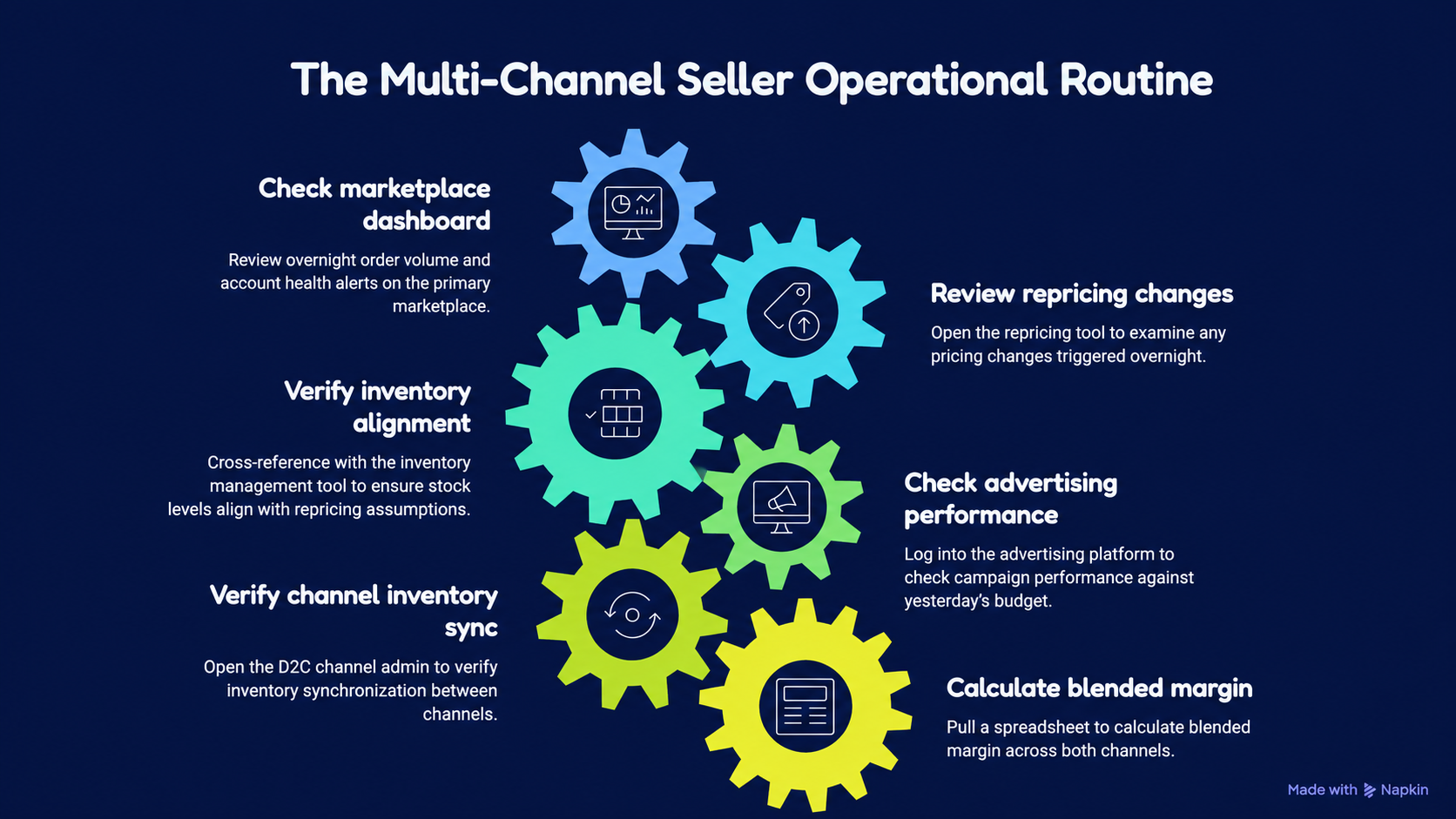
Every commerce tool has an optimization target. Repricing tools optimize for Buy Box win rate. Advertising tools optimize for ACOS or ROAS. Inventory tools optimize for in-stock rate. Listing tools optimize for keyword rankings.
Each of these targets sounds reasonable. None of them is your actual goal.
A seller’s actual goals are things like: achieve a 20% blended margin across all channels. Grow revenue by 40% year-over-year without proportionally increasing operational headcount. Maintain 95%+ in-stock rate while reducing working capital tied up in inventory. Expand to Walmart without degrading Amazon performance.
These are business goals. The metrics that commerce tools optimize for are proxy metrics. They correlate with business outcomes but don’t guarantee them. You can win the Buy Box 90% of the time and still lose money. You can achieve a 25% ACOS and still have negative unit economics on that ASIN. You can maintain 99% in-stock rate and still over-invest in slow-moving inventory.
The proxy metric trap
The danger of proxy metrics is that they become the goal. When your repricing tool reports an 85% Buy Box win rate, that feels like success. When your advertising tool reports an improving ACOS trend, that feels like progress. When your inventory tool reports zero stockouts this month, that feels like operational excellence.
But the seller checking blended profitability in a spreadsheet, because no single tool can calculate it, discovers that margin declined even as every proxy metric improved. The repricing tool lowered prices to win the Buy Box. The advertising tool increased spend to maintain ACOS at a lower price point. The inventory tool reordered aggressively to maintain in-stock rate on faster-moving (but now lower-margin) ASINs.
Each tool optimized for its target. The business got worse.
This isn’t a failure of any individual tool. It’s a structural failure of the fragmented architecture. When tools optimize independently, they can work against each other without either tool, or the seller, realizing it until the damage appears in month-end reporting [1].
Goal-first architecture
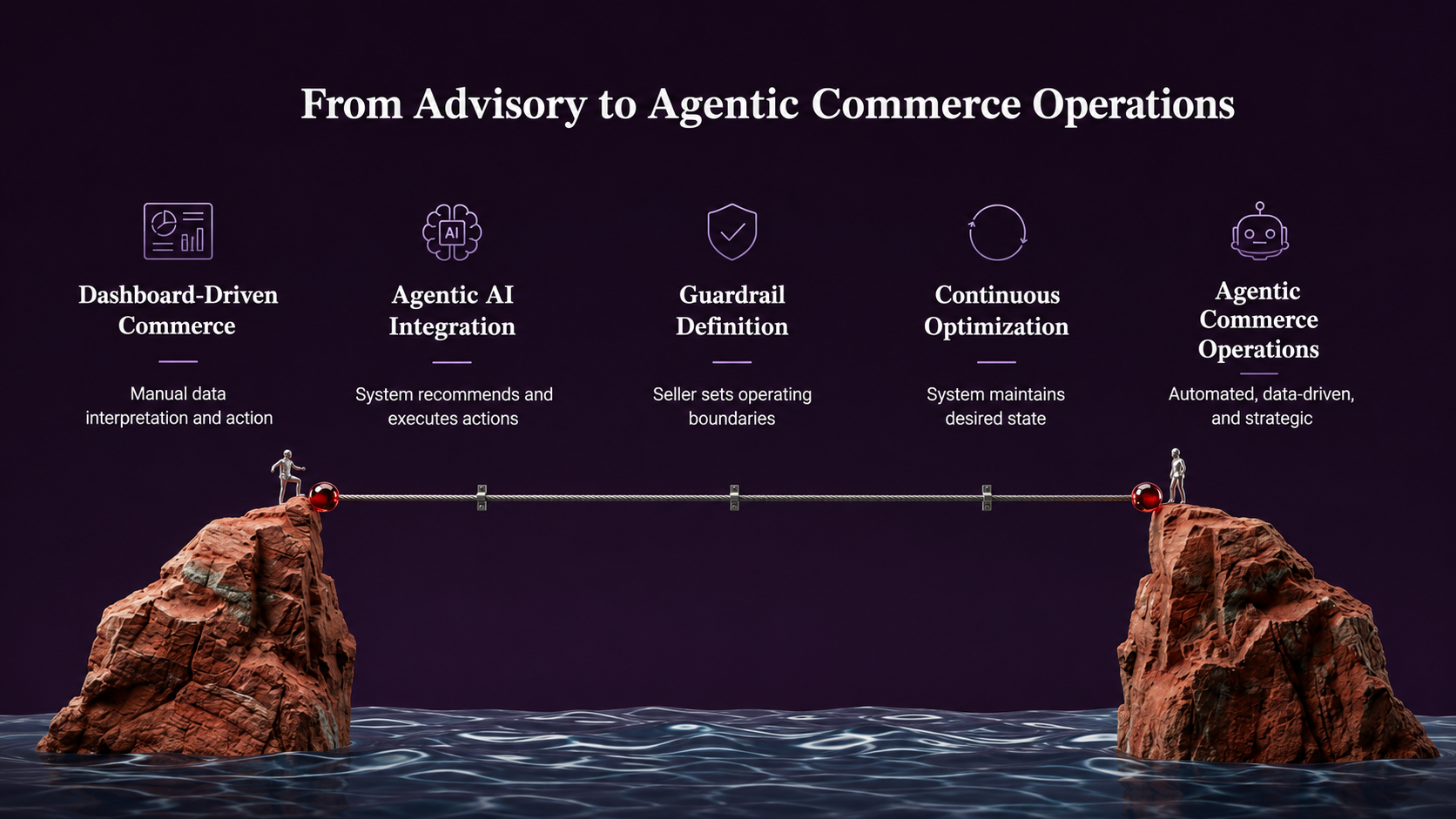
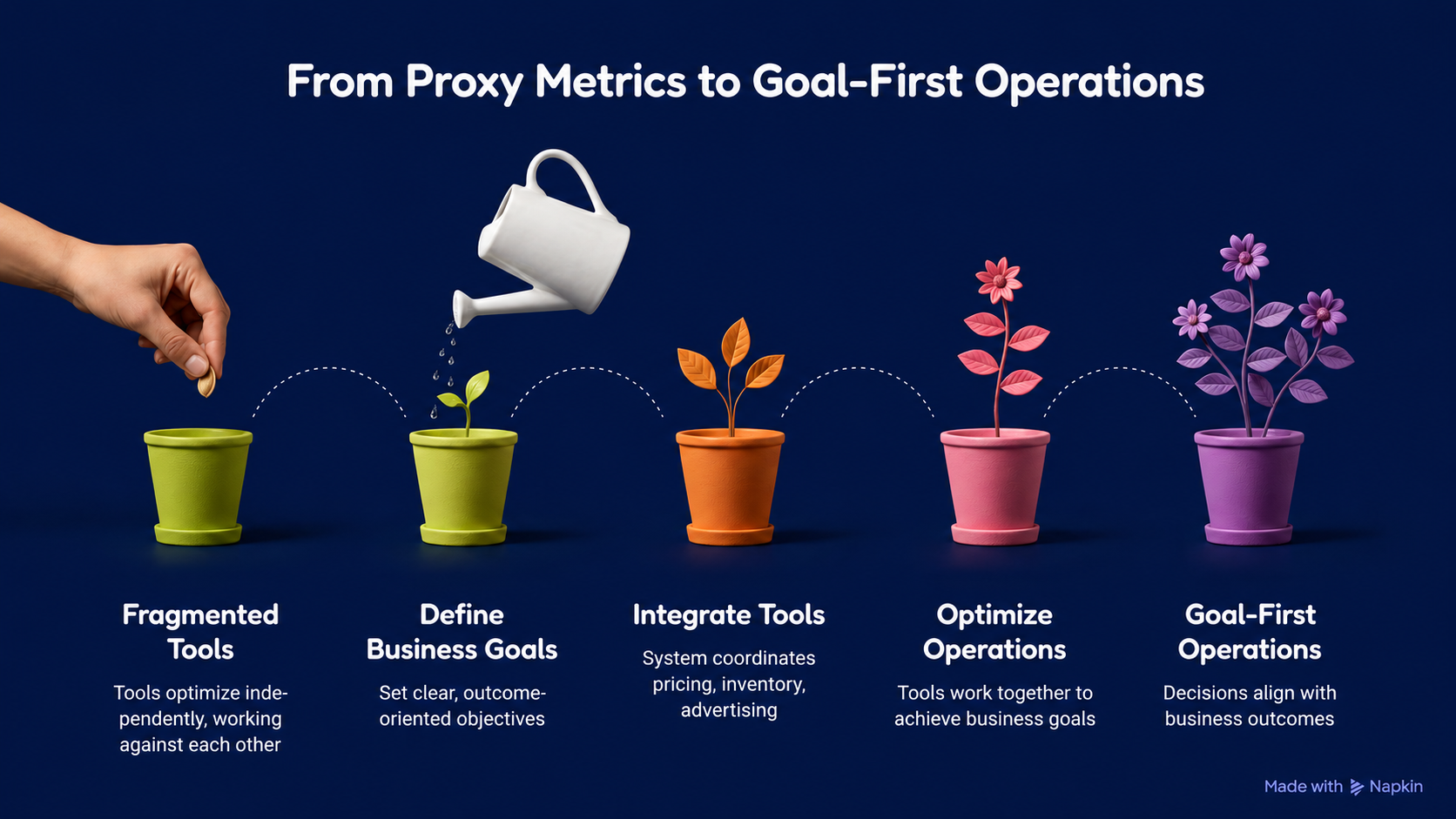
Realify is designed around a different principle: define the business outcome first, then let the system determine which operational levers to pull to achieve it.
When you set a 20% blended margin target in Realify, the pricing, inventory, and advertising capabilities all orient around that target. The pricing engine won’t lower prices to win the Buy Box if doing so would push the ASIN below margin threshold, unless the inventory position and advertising investment make the temporary margin reduction strategically sound. The advertising engine won’t increase spend on an ASIN unless the current margin supports the incremental cost. The inventory engine factors in carrying cost and aged-inventory penalties when calculating optimal reorder quantities.
These aren’t separate decisions happening in separate tools. They’re coordinated decisions happening in one system with shared visibility into the business outcome.
The practical difference
Here is a scenario that illustrates the difference.
A competitor on Amazon drops their price on your top-selling ASIN by 8%. In a fragmented tool stack, here’s what happens: your repricing tool matches or undercuts the price. Your advertising tool continues spending at the same level (now driving traffic to a lower-margin listing). Your inventory tool, seeing increased velocity from the price drop, triggers a reorder. You’ve just committed to selling more units at lower margin with the same advertising spend, and you won’t see the margin impact for days.
In Realify, the same competitive price drop triggers a different sequence. The system evaluates: the competitor’s stock level (are they clearing inventory or committing to a new price point?), your current inventory position (do you need to compete or can you wait?), the margin impact of matching (does it violate your 20% target?), and the advertising ROI at the new price point (is the current spend still justified?). Based on this analysis, the system might: hold price and pause advertising on that ASIN (preserving margin while the competitor burns through stock), or match the price but reduce advertising spend (competing on price without doubling down on a lower-margin position), or flag the decision for your review because the optimal response depends on strategic context the system doesn’t have.
In each case, the decision works back from your stated goal, 20% blended margin, rather than forward from a proxy metric.
Setting up for goal-first operations
If you’re considering the shift from proxy-metric tools to goal-first operations, the starting point is clarity about your actual business objectives. Not “win the Buy Box” but “maintain X% margin on my top 50 ASINs.” Not “reduce ACOS” but “achieve Y% ROAS on advertising spend across all channels.” Not “stay in stock” but “optimize working capital allocation across Z fulfillment methods.”
Realify helps you define these goals during onboarding and calibrates every capability, pricing, inventory, advertising, competitive intelligence, and forecasting, to work back from them. The result isn’t just better individual decisions. It’s decisions that move your business in a coherent direction, every day, across every channel.
- •[1] Analysis based on seller-reported experiences in Amazon Seller Central Forums and documented in Canopy Management’s “Invisible Challenges” report, 2025-2026.