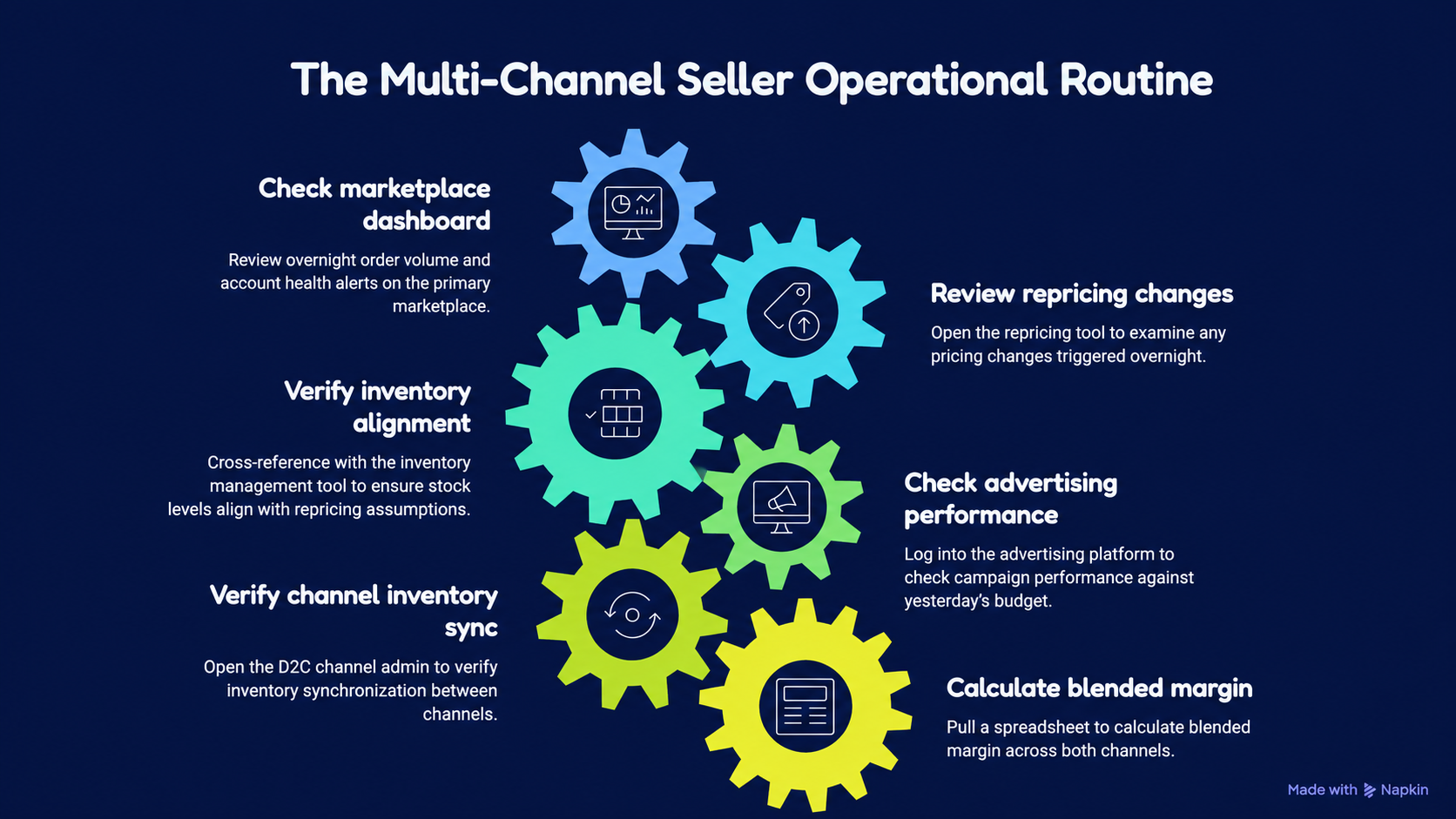
Open any seller tool built in the last decade and you’ll find the same architecture: a dashboard. Data in. Charts out. The seller interprets, decides, and acts. The tool’s job is done the moment it renders a graph.
This was a reasonable design when Amazon was a simpler marketplace. When a seller managed 50 SKUs on one channel, a daily review of a pricing dashboard was sufficient. Competitive changes were slow. Fee structures were stable. The number of decisions a seller needed to make in a day was small enough that a human could process them one by one.
That world no longer exists.
A seller managing 500 SKUs across Amazon and Walmart generates thousands of data points daily, price movements, inventory changes, advertising performance fluctuations, competitive entries and exits, listing quality shifts, and fee adjustments. The volume of information that requires evaluation exceeds what a dashboard can usefully present and what a human can reliably process [1].
The gap between information and action
The fundamental limitation of the dashboard paradigm is that it optimizes for visibility, not velocity. Knowing that a pricing error exists isn’t the same as fixing it. Seeing that inventory is misallocated across channels isn’t the same as reallocating it. Identifying that advertising spend is wasting budget on an ASIN approaching stockout isn’t the same as pausing the campaign.
In commerce, the time between information and action is where money is made or lost. Amazon’s marketplace operates in real-time. Buy Box rotations, competitive repricing, and demand shifts happen continuously. A pricing decision that’s optimal at 9:00 AM may be suboptimal by noon. An inventory allocation that was correct on Monday may be wrong by Wednesday.
Dashboard-era tools place the full burden of this real-time processing on the seller. The tool shows you what happened. You figure out what it means. You decide what to do. You go to another tool to do it. The elapsed time from signal to action can be hours or days, during which the market has already moved.
The shift from advisory to agentic
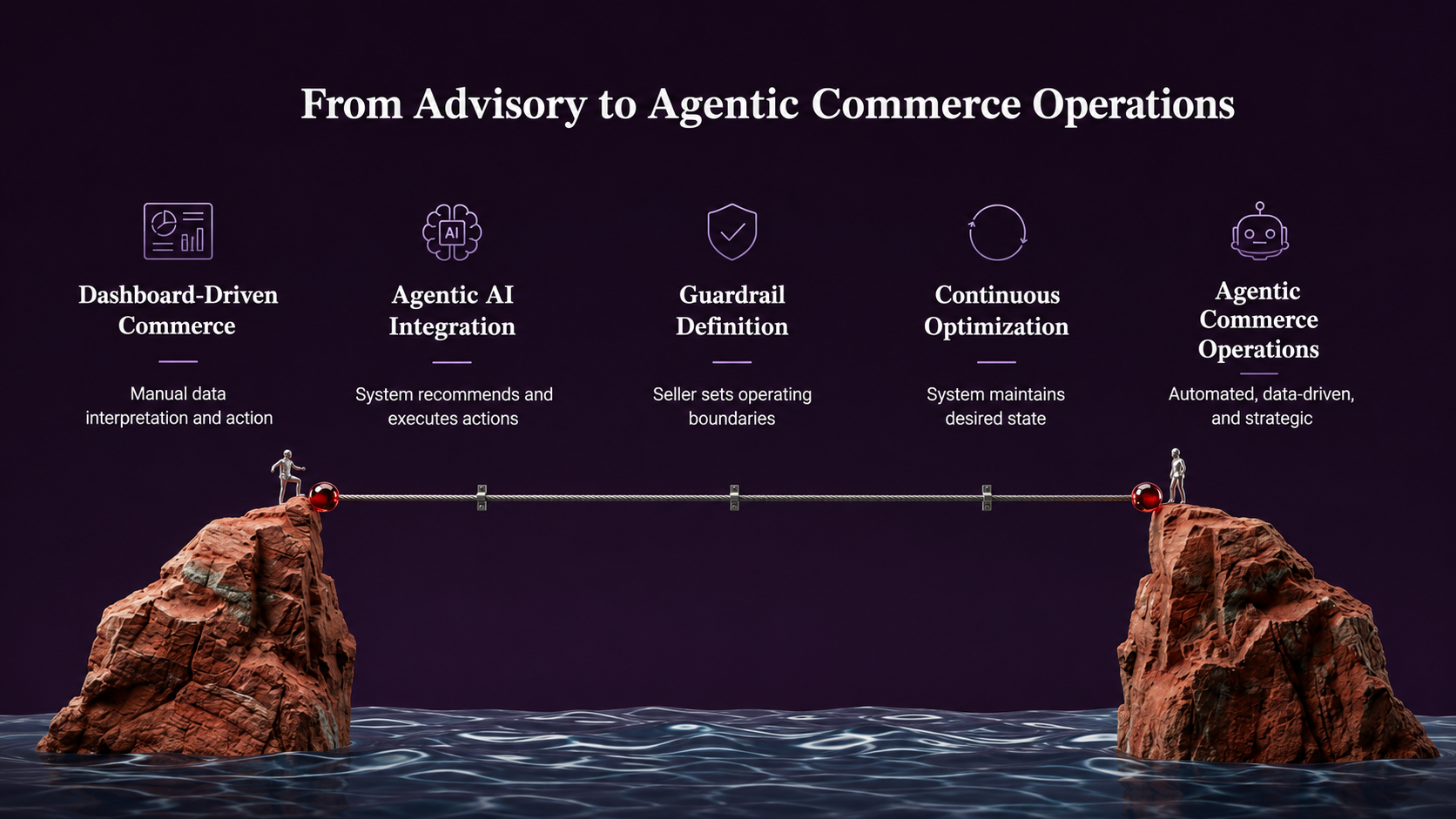
The next generation of commerce infrastructure is built on a different premise: the system shouldn’t just tell you what happened. It should tell you what to do, and, within boundaries you define, do it.
This is the distinction between advisory AI and agentic AI. Advisory AI generates recommendations. Agentic AI generates recommendations and, where authorized, executes them. Advisory AI requires a human in every loop. Agentic AI allows the human to define the loops and step in when needed.
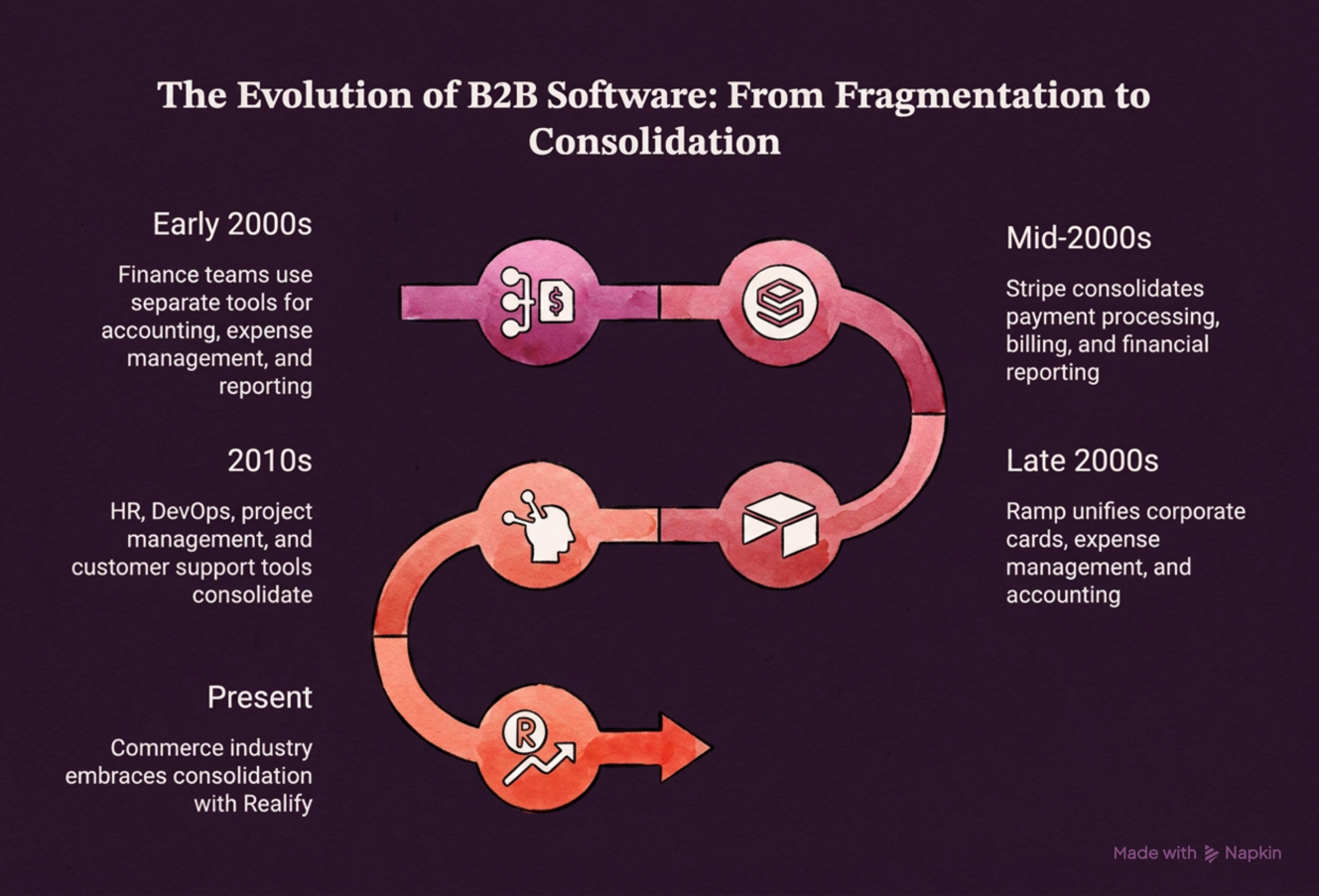
The commerce industry’s adoption of this pattern is following the trajectory of adjacent fields. In financial services, algorithmic trading didn’t start with full automation. It started with recommendation systems that progressively earned trust and expanded scope. In customer service, AI didn’t replace human agents overnight. It started by handling routine inquiries and escalating complex ones. In each case, the transition from advisory to agentic was gradual, trust-based, and governed by clear guardrails.
Why guardrails matter more than capabilities
The conversation about automation in commerce often focuses on what the system can do. The more important question is what the system is allowed to do, and who decides.
Realify is built on the principle that the seller defines the operating boundaries. You set the minimum margin threshold. You define the maximum price change in a single adjustment. You specify which actions require your approval and which can execute automatically. The system operates within these guardrails, and when it encounters a situation outside the defined parameters, it surfaces the decision to you rather than acting unilaterally.
This architecture matters because trust in autonomous systems isn’t built through capability demonstrations. It’s built through consistent, predictable behavior within understood boundaries. A seller who sets a guardrail at “never reprice below a 15% margin” and sees the system reliably honor that boundary will progressively expand the system’s autonomy. A seller whose system makes unexplained decisions will revoke access within a week, regardless of how sophisticated the algorithm is [2].
From dashboards to operating systems
The difference between a dashboard and an operating system is the difference between a weather report and a thermostat. A weather report tells you the temperature. A thermostat tells you the temperature and maintains the one you set. You don’t check your thermostat every hour. You set the desired state, and the system maintains it.
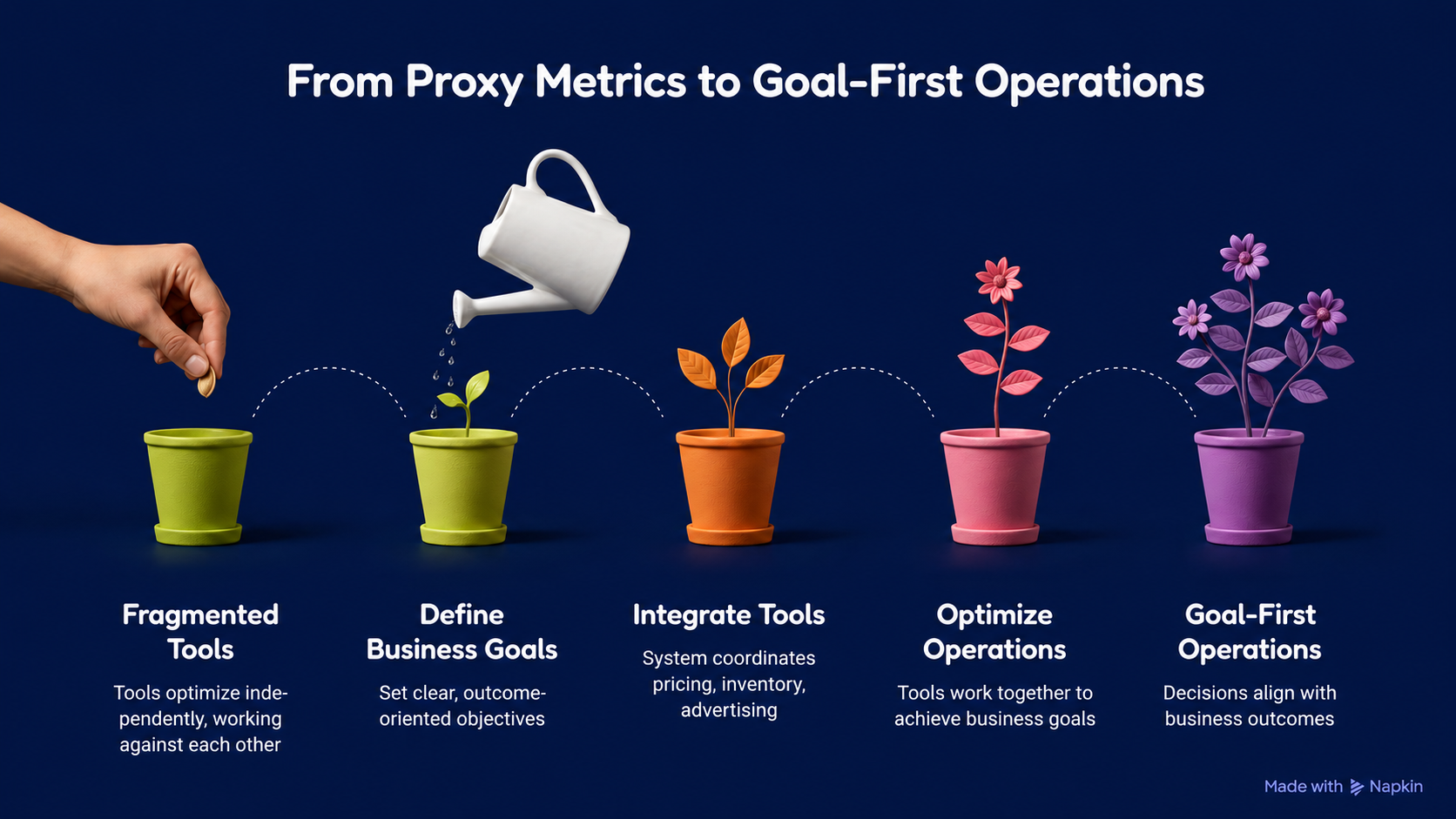
Realify’s approach to commerce operations follows this pattern. You define the desired state, target margins, inventory levels, advertising efficiency, competitive positioning, and the system works continuously to maintain it. When conditions change, the system adapts within your guardrails. When it can’t adapt without exceeding your boundaries, it tells you what changed and what your options are.
This isn’t theoretical. It’s how every other operational domain has evolved, and it’s how commerce will evolve for sellers who recognize that their time is better spent on strategy than on processing dashboards.
- •[1] Amazon Seller Central Forums, analysis of seller challenges, 2025. Advertising management, pricing errors, and sales performance diagnosis consistently require cross-tool investigation.
- •[2] Based on trust-building patterns documented in autonomous systems research and applied AI deployment case studies across financial services and logistics, 2023-2025.