Every major B2B software category has followed the same evolutionary arc: fragmentation, frustration, consolidation. The commerce industry is about to complete the same journey, and the sellers who recognize the pattern will have a decisive advantage.
The pattern
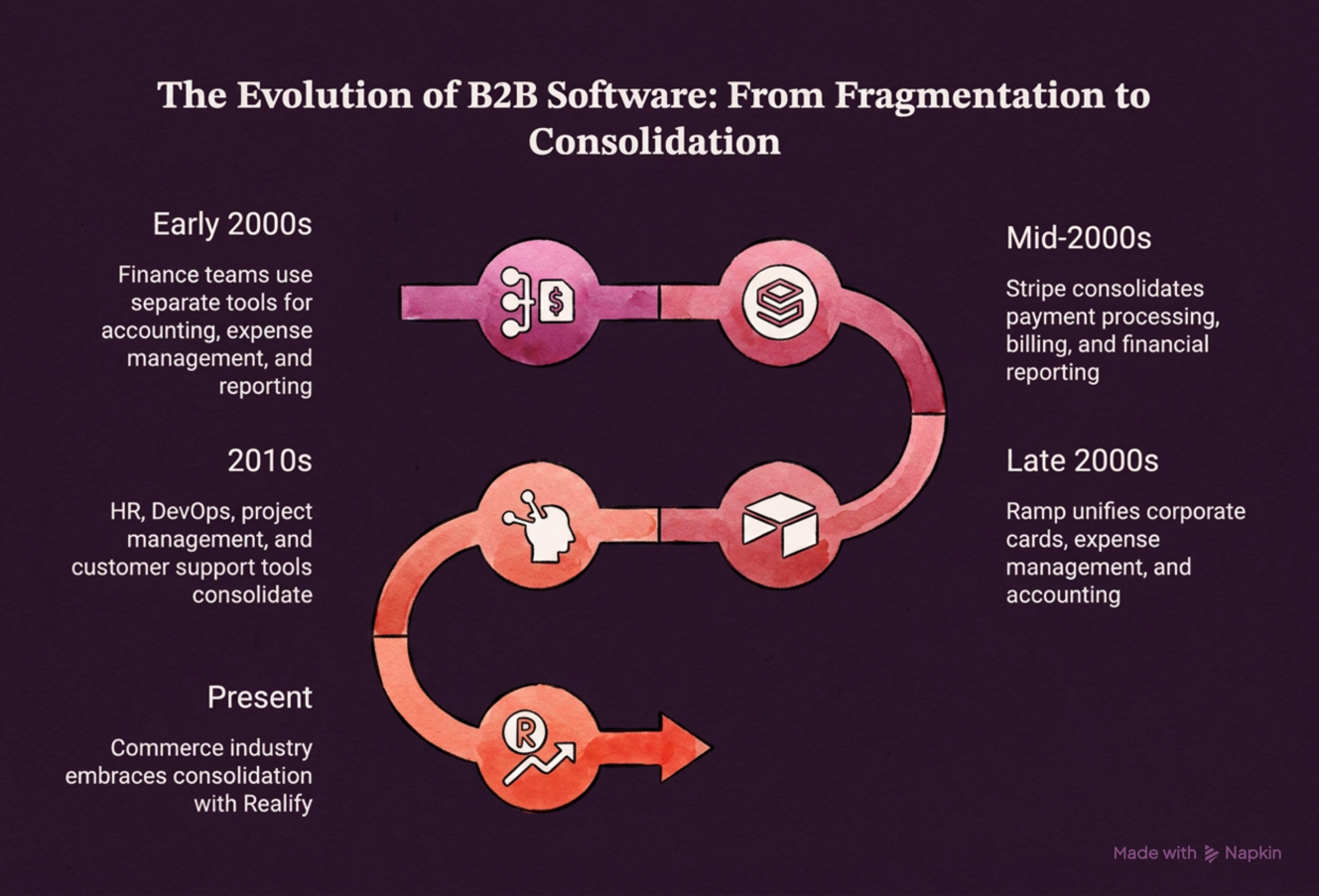
In the early 2000s, a finance team’s software stack looked remarkably like a modern seller’s: separate tools for accounting, expense management, bill payment, invoicing, corporate cards, and financial reporting. Each tool was the strongest option in its domain. None talked to the others. The finance team spent its days reconciling data across systems and manually enforcing policies that no single tool could implement [1].
Then platforms emerged. Stripe consolidated payment processing, billing, invoicing, and financial reporting into a single infrastructure layer. Ramp unified corporate cards, expense management, bill payment, and accounting. The value wasn’t that any individual capability improved. It was that the boundaries between capabilities disappeared. A payment in Stripe automatically updated the revenue report. An expense in Ramp automatically categorized itself and checked against policy.
The same pattern played out in HR (Rippling consolidated payroll, benefits, IT, and compliance), DevOps (Datadog consolidated monitoring, logging, alerting, and security), project management (Linear consolidated issue tracking, project planning, and engineering workflows), and customer support (Intercom consolidated messaging, help desk, and product tours).
In each case, the consolidation thesis was the same: when operational domains are interconnected, the tools serving them must be interconnected too. Otherwise, the human operator becomes the integration layer, and humans are the slowest, most expensive, and least reliable integration layer available.
Commerce: the last holdout
Multi-channel commerce is the last major B2B category still operating on a fragmented tool paradigm. The reasons are understandable. Amazon’s ecosystem evolved rapidly, creating specialized niches that point solutions filled. Sellers were growing fast enough that operational friction was tolerable. And the native seller interfaces provided by each marketplace platform offered just enough built-in functionality to make the tool stack feel manageable.
But the marketplace has changed. Fee structures have grown more complex, with marketplace platforms now operating multi-layered cost frameworks encompassing referral charges, fulfillment fees, storage fees, placement fees, return processing fees, and API access costs. Advertising has shifted from optional to essential, with average ACOS rising across most categories. Competition has intensified as Chinese sellers now represent over 50% of Amazon’s top sellers [3]. And channel expansion, from Amazon to Shopify to Walmart to TikTok Shop, has multiplied the operational surface area.
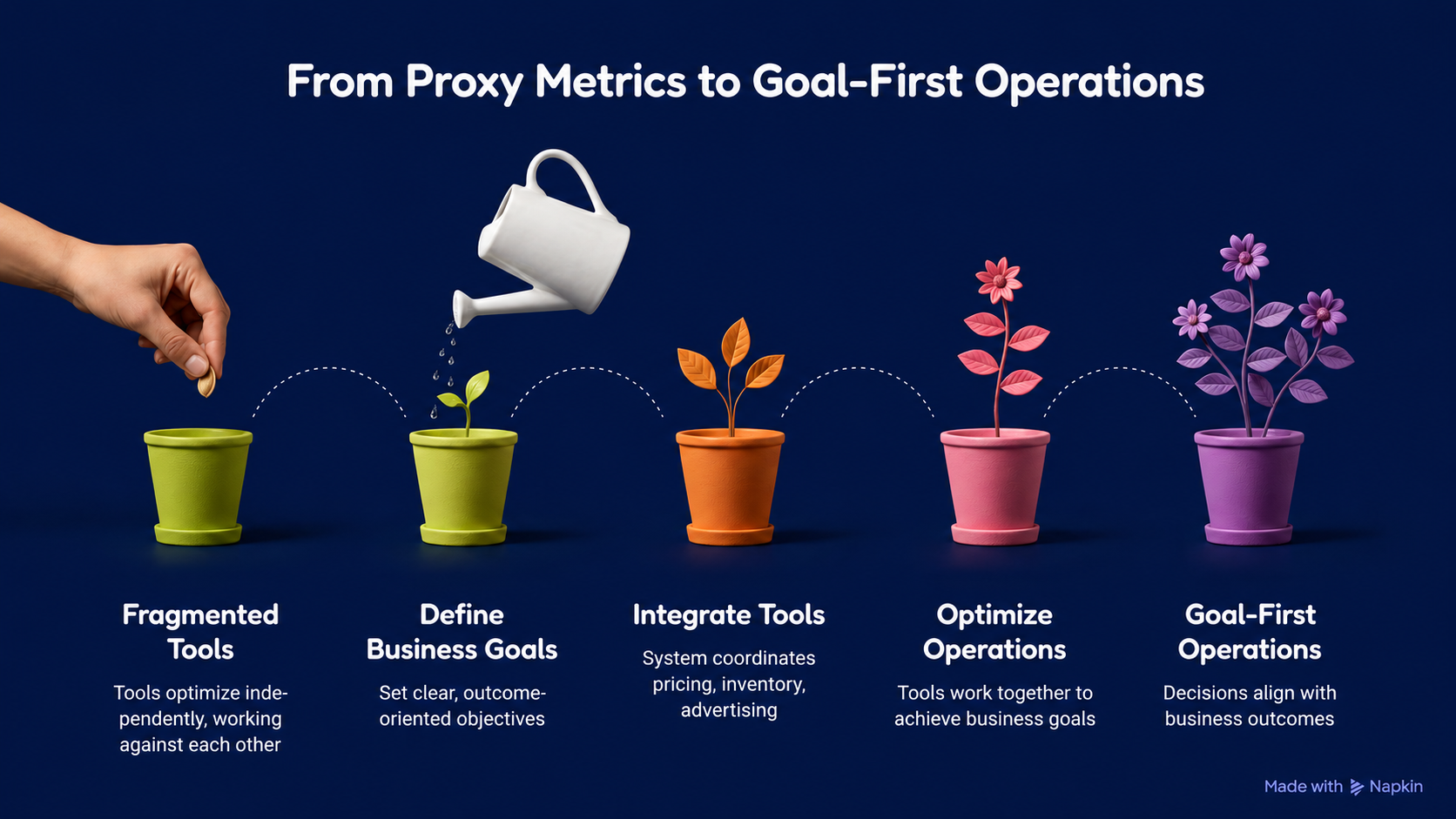
In this environment, the fragmented tool stack doesn’t just fail to scale. It actively impedes the decisions that drive growth. When your repricing tool can’t see your advertising spend, it makes pricing decisions that undermine your ad ROI. When your inventory system can’t see your competitive position, it reorders based on historical velocity without accounting for market shifts. When your advertising platform can’t see your margin at the SKU level, it optimizes for ACOS without regard for profitability.
What a commerce operating system looks like
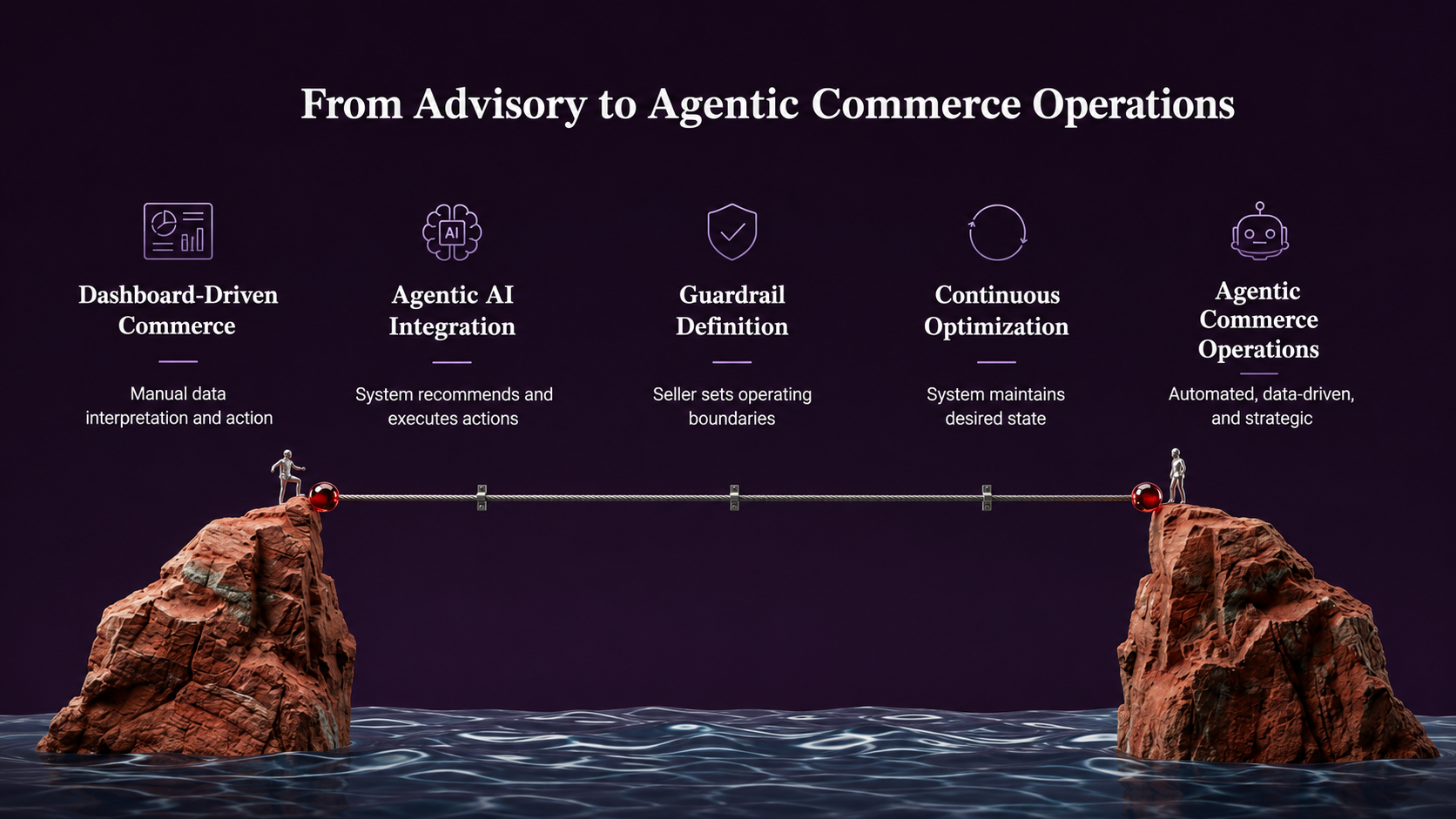
Realify is built on the consolidation thesis applied to commerce. Instead of a pricing tool, an inventory tool, an advertising tool, a competitive intelligence tool, and a reporting tool, each operating in isolation, Realify provides a single system where every operational domain shares the same data layer, the same decision engine, and the same execution framework.
When a competitor drops their price on Amazon, the pricing capability considers the inventory position, the advertising investment, the D2C price for the same product, and the margin impact before responding. When demand shifts on one channel, the inventory capability reallocates across channels and fulfillment methods in concert. When an advertising campaign’s ACOS spikes, the system evaluates whether the root cause is competitive pricing, listing quality, or market-level demand decline, and surfaces the appropriate action across capabilities.
This cross-domain intelligence is what distinguishes an operating system from a collection of tools. The tools see their domain. The operating system sees the business.
The timing question
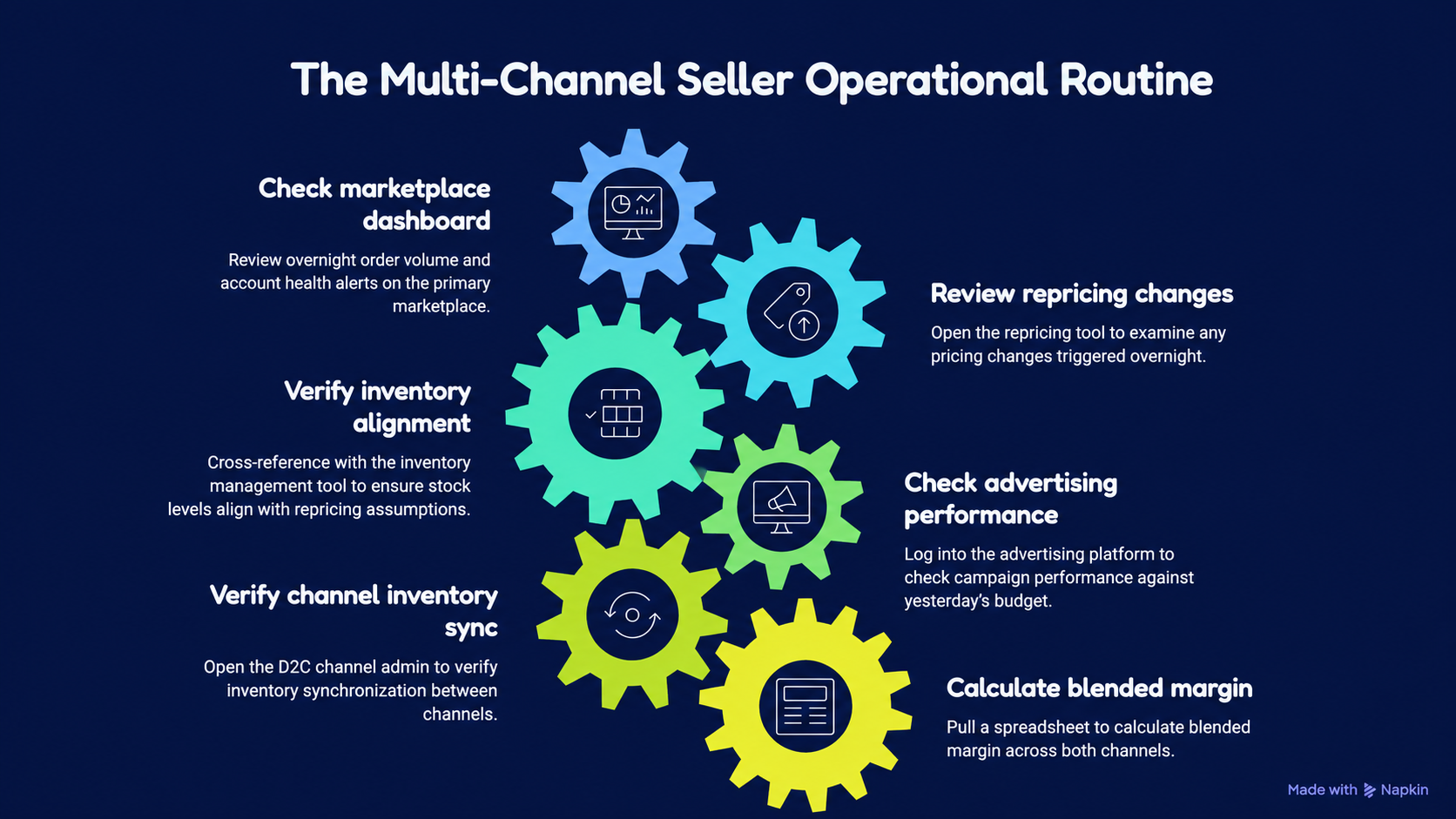
Sellers often ask: is it too early for this? The answer depends on how you’re currently spending your time. If your mornings are consumed by reconciling data across tools, manually checking that pricing aligns with inventory aligns with advertising, and building spreadsheets to see your blended margin, the platform shift isn’t premature. It’s overdue.
The sellers who adopted Stripe before their payment volume demanded it, who moved to Datadog before their infrastructure required it, who switched to Linear before their team outgrew their issue tracker, these are the businesses that scaled without their operations becoming the bottleneck.
Commerce is at the same inflection point. The operating system era isn’t coming. It’s here.
- •[1] Ramp, “The State of Business Spend,” 2024. Documented the fragmentation of finance tools pre-consolidation.
- •[2] Amazon SP-API fee announcement, January 2026: $1,400 annual developer subscription plus volume-based GET call fees.
- •[3] Marketplace Pulse, “Amazon Seller Statistics,” 2025. Chinese sellers represent 50%+ of top Amazon.com sellers.