There is a moment, somewhere between the third spreadsheet and the fifth browser tab, when a multi-channel seller realizes something uncomfortable: the tools that were supposed to simplify their business have become the business.
The typical Amazon seller managing operations across two or three channels maintains active subscriptions to between five and seven distinct software platforms [1]. One for repricing. One for inventory. One for advertising. One for keyword research. One for competitive intelligence. And then a spreadsheet (always a spreadsheet) attempting to reconcile what none of these tools can see together.
This isn’t a startup problem. Sellers doing $500K to $10M in annual revenue are the most acutely affected. They’ve outgrown manual management but haven’t reached the scale where a full-time operations team can absorb the complexity. They sit in a gap where the tools are supposed to do the work, but the tools themselves have become the work.
The compounding cost of fragmentation
The direct subscription cost is the most visible and least important expense. A typical multi-channel seller’s tool stack runs between $500 and $2,000 per month across platforms, meaningful but manageable at scale [2]. The real cost is in three less visible categories.
The first is reconciliation time. When your pricing tool doesn’t talk to your inventory system, and neither talks to your advertising platform, someone has to manually verify that reality matches expectation across all three. Amazon’s own seller forums identified pricing and promotion errors as a top-five challenge in 2025, with sellers reporting errors running undetected for days because no single system had the full picture [3].
The second is decision latency. When information is distributed across seven tools, the time between “something changed” and “we responded” expands from minutes to days. A competitor drops their price on your best-selling ASIN at 2:00 AM. Your repricing tool catches it at 6:00 AM. You notice in your morning review at 9:00 AM. You check inventory implications in a different tool at 10:00 AM. You adjust your advertising bid in a third tool at 11:00 AM. Nine hours elapsed. In a marketplace where Buy Box rotations happen in real-time, nine hours is a lifetime.
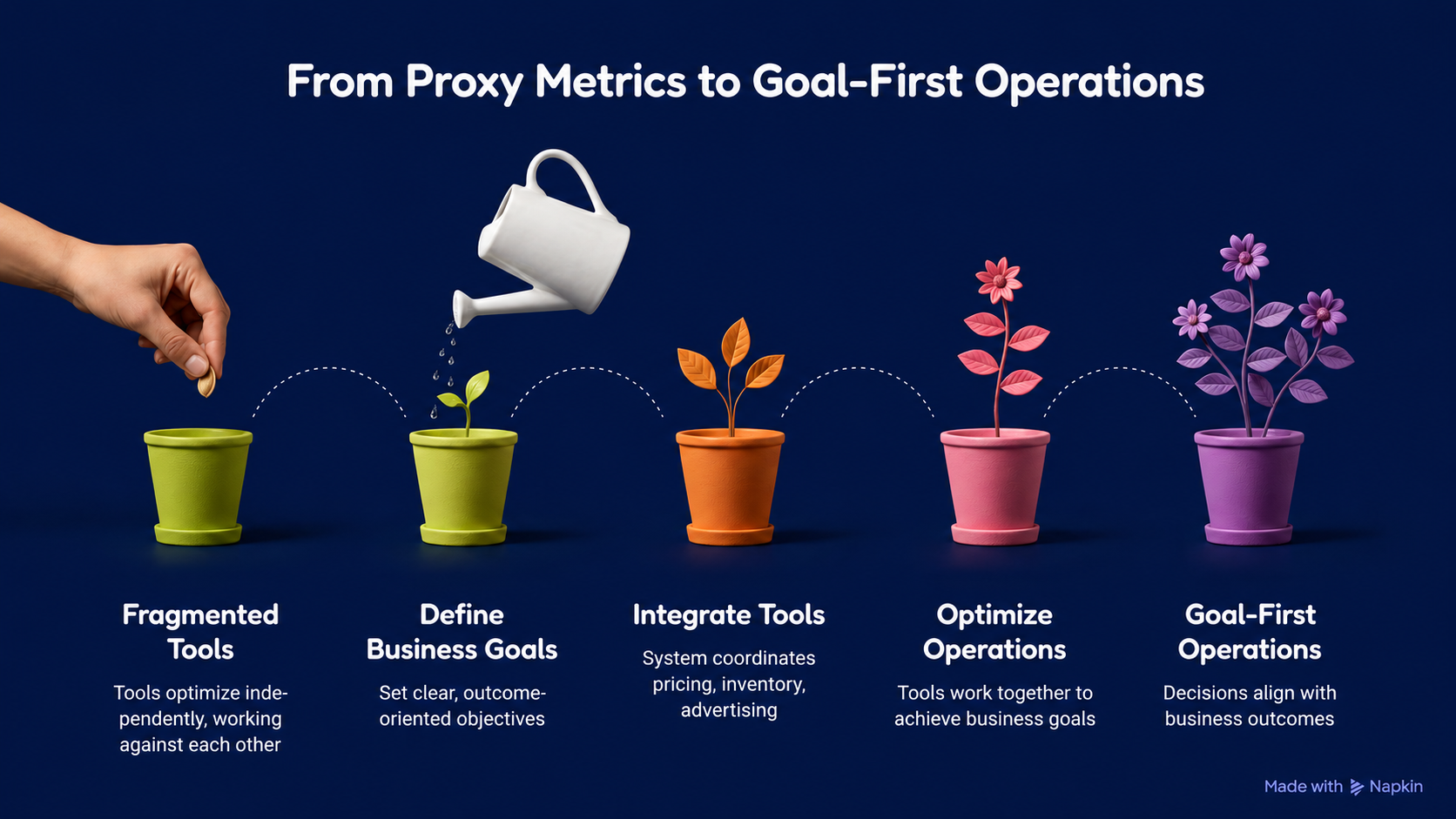
The third, and largest, cost is invisible margin erosion. When pricing, inventory, and advertising operate independently, they optimize locally rather than globally. Your repricing tool lowers price to win the Buy Box without knowing your advertising cost has spiked on that ASIN. Your inventory system reorders based on trailing velocity without knowing a competitor just stocked out (creating a demand surge). Your advertising tool increases budget on an ASIN that’s about to hit low-stock threshold. Each decision is rational in isolation. Together, they erode margin in ways no single dashboard reveals.
The reconciliation tax
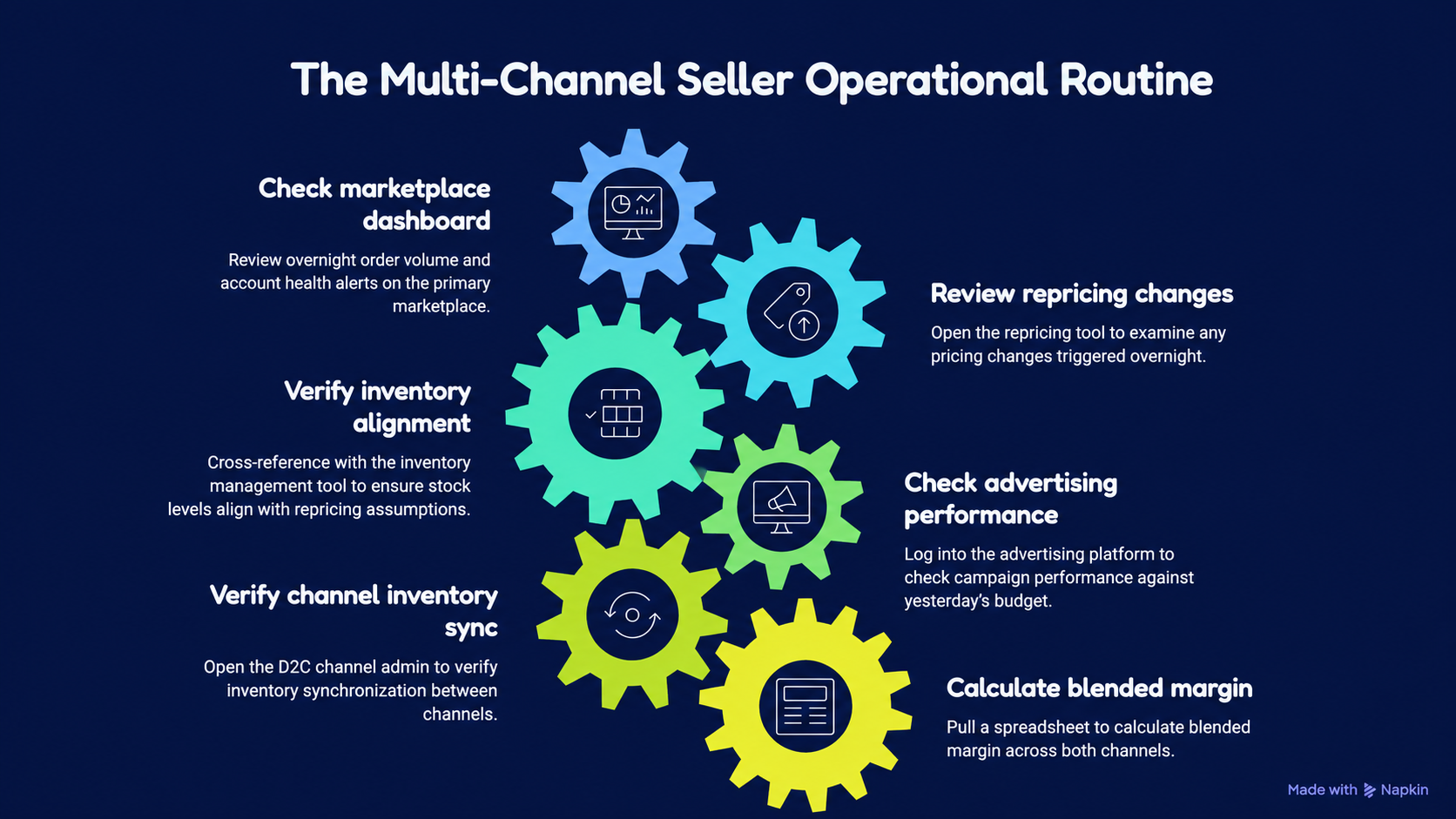
Consider a concrete scenario. A seller operates across a primary marketplace and a D2C channel with 400 active SKUs. Their morning operational routine looks like this:
Check the primary marketplace dashboard for overnight order volume and account health alerts. Open their repricing tool to review any pricing changes triggered overnight. Cross-reference with their inventory management tool to ensure stock levels align with the repricing tool’s assumptions. Log into their advertising platform to check campaign performance against yesterday’s budget. Open the D2C channel admin to verify inventory sync between channels. Pull a spreadsheet to calculate blended margin across both channels because no single tool provides this view.
This routine takes between 45 minutes and two hours every morning. Across a year, that’s 195 to 520 hours of operational time, the equivalent of 5 to 13 full working weeks, spent not on strategy, not on product development, not on growth, but on verifying that disconnected systems haven’t drifted out of alignment.
Amazon’s seller community forums confirm this pattern at scale. An analysis of over 4,000 forum discussions in 2025 revealed that the top seller challenges clustered around exactly the seams between tools: advertising campaigns stopping unexpectedly or underperforming (tool A), payment and financial tracking discrepancies (tool B), pricing and promotion configuration errors (tool C), and sales performance declines that sellers couldn’t diagnose because the data lived in multiple systems [3].
Why this happened, and why it persists
The commerce software market evolved the way most software markets do: vertically. Each major pain point spawned a dedicated solution. Pricing became its own category. Inventory became its own category. Advertising became its own category. Each tool optimized for its domain and measured success by how well it performed within that domain.
This vertical evolution made sense when sellers operated on a single channel with a manageable catalog. A repricing tool on Amazon and a D2C storefront theme was a sufficient stack for a $200K business. But when that business grows to $2M across three channels, the stack doesn’t scale. It fragments.
The deeper structural issue is that commerce operations are fundamentally interconnected. Pricing affects demand. Demand affects inventory velocity. Inventory velocity affects fulfillment cost. Fulfillment cost affects margin. Margin affects how aggressively you can price. It’s a system, but the tools treat each element as independent.
The operating system alternative
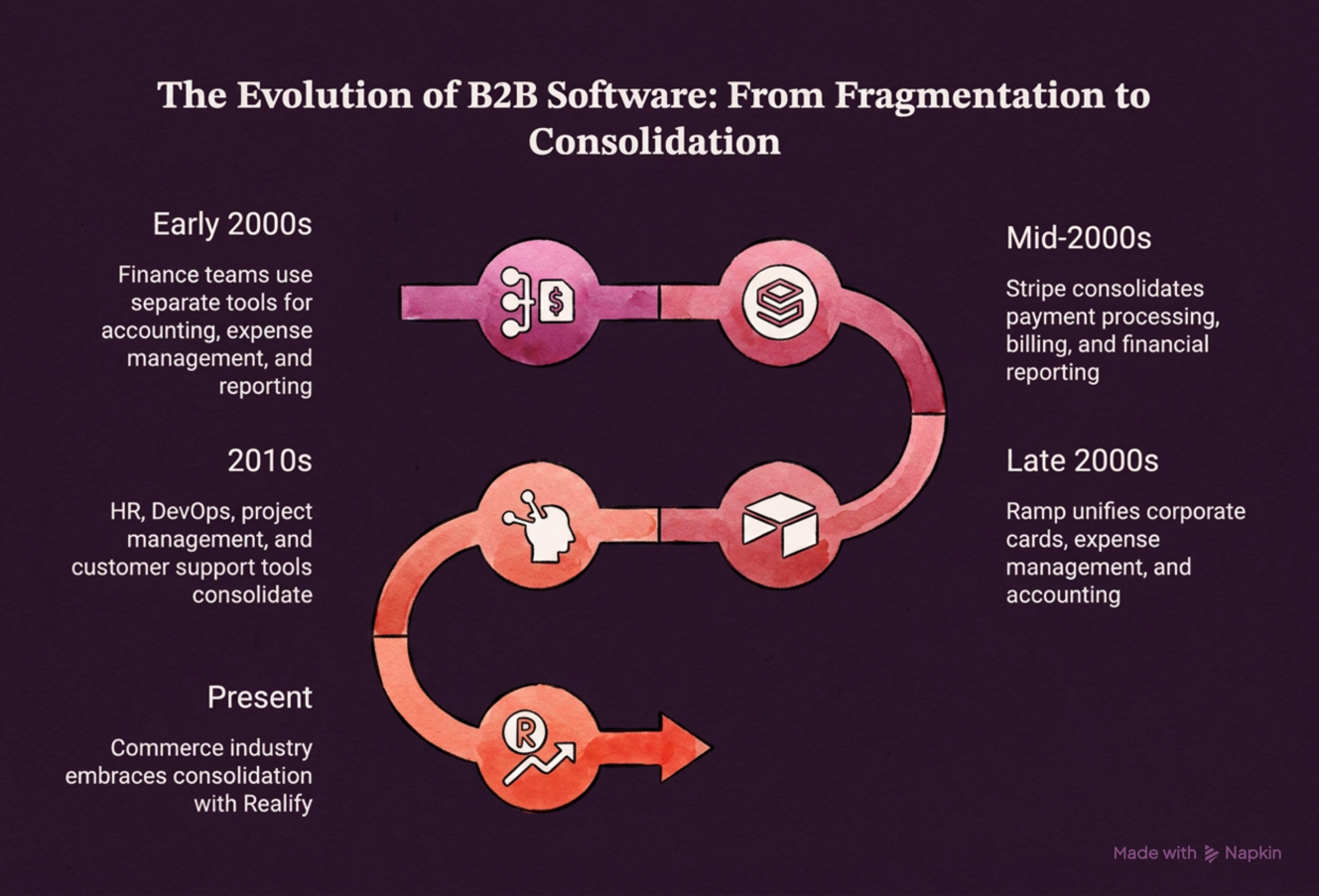
The pattern of vertical tools consolidating into platforms has played out in every adjacent industry. Finance went from QuickBooks plus Expensify plus Bill.com to platforms like Ramp that handle expense management, bill payment, and accounting in one system. Developer operations went from separate monitoring, logging, and alerting tools to observability platforms like Datadog. Project management went from Trello plus Asana plus Slack threads to integrated systems like Linear.
In each case, the consolidation wasn’t just about convenience. It was about decisions that require cross-domain visibility. You can’t make a good budgeting decision without seeing expenses. You can’t diagnose a production incident without correlated logs and metrics. And you can’t make a good pricing decision without seeing inventory, advertising, and competitive context simultaneously.
This is the thesis behind Realify: that multi-channel commerce has reached the point where an operating system, a single platform where pricing, inventory, advertising, competitive intelligence, and margin tracking plan together, execute together, and learn together, isn’t a nice-to-have. It’s the prerequisite for making decisions at the speed the marketplace demands.
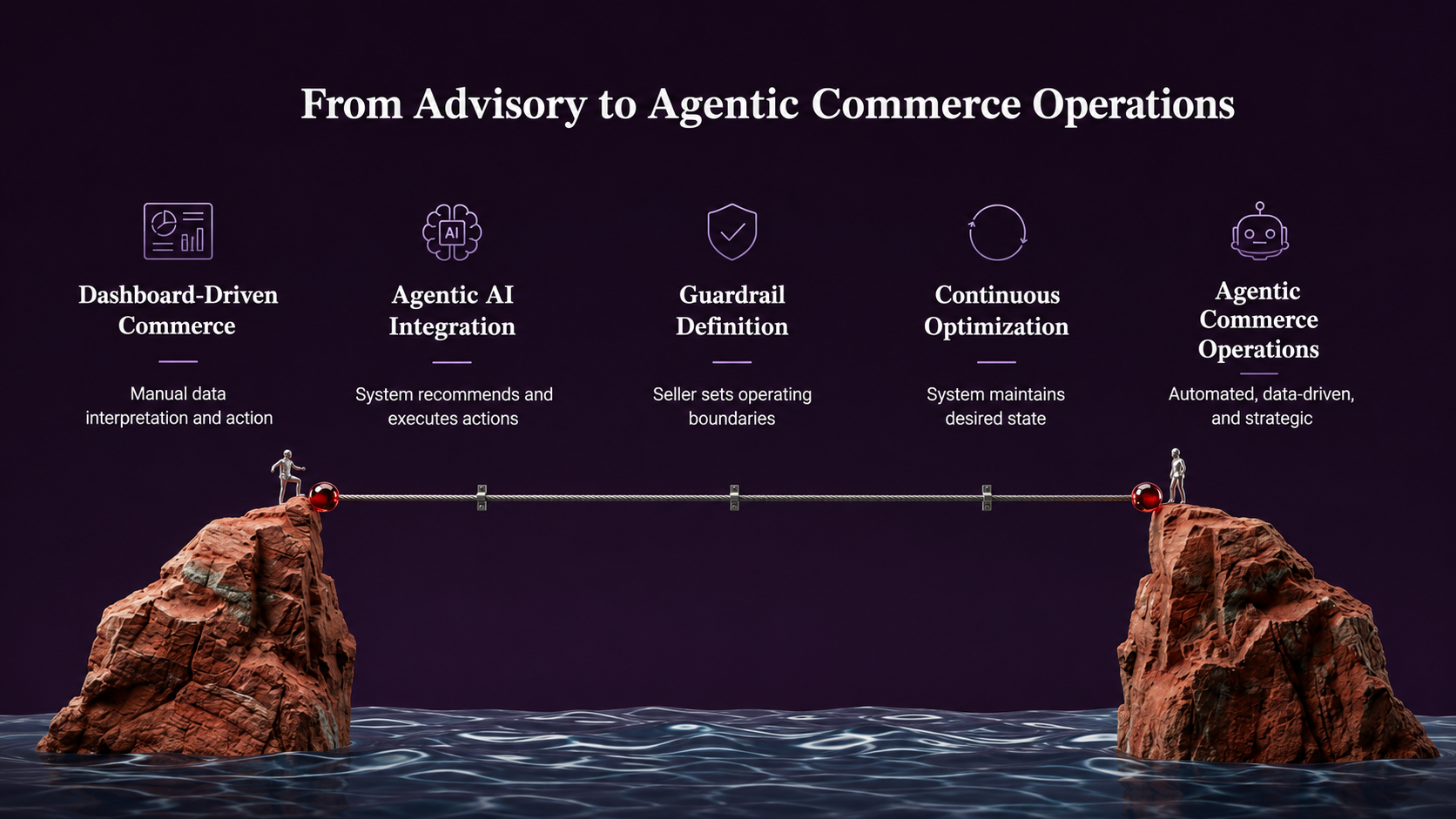
Realify replaces the seven-tool stack with one system that connects to Amazon, Shopify, Walmart, and other marketplaces through official, authorized APIs. When a competitor drops their price, Realify doesn’t just flag it in a repricing tool. It evaluates the inventory position, the advertising spend on that ASIN, the margin impact, and the cross-channel implications before recommending (or, within your defined guardrails, executing) a response.
The difference isn’t incremental improvement to any single capability. It’s the elimination of the gaps between capabilities, the reconciliation time, the decision latency, and the invisible margin erosion that no individual tool can see, let alone solve.
What this means for your business
If you’re running a multi-channel business on a fragmented tool stack, the question isn’t whether fragmentation is costing you. It is. The question is whether you can see the cost, and most sellers can’t, because the very tools they rely on are blind to it.
The sellers who will thrive in 2026 and beyond aren’t the ones with the best individual tools. They’re the ones whose tools work as a system, where every decision is informed by the full operational picture, and every action accounts for its cross-domain consequences.
That’s what a commerce operating system is built to do. And that’s why we built Realify.
- •[1] Industry analysis based on common seller tech stacks documented across Helium 10, Jungle Scout, and SellerApp feature comparisons, 2025-2026.
- •[2] Estimated based on published pricing for Helium 10 ($229-$399/mo), Jungle Scout ($49-$399/mo), RestockPro ($59-$499/mo), SellerBoard ($19-$79/mo), and advertising tools ($100-$500/mo).
- •[3] Amazon Seller Central Forums, “Seller Poll: Your Biggest Growth Challenges in 2025,” analysis of 4,000+ forum discussions, December 2025.