Amazon’s Rufus AI shopping assistant, rolled out across the US marketplace in 2024-2025, represents the most significant change to product discovery since the A9 search algorithm was introduced. For sellers, it creates a new optimization surface that most haven’t yet adapted to.
Rufus allows shoppers to ask natural language questions about products, “what’s a good wireless headphone for running in the rain?”, and receive AI-generated answers that reference specific products and product attributes. These answers draw from listing content, reviews, Q&A sections, and product specifications [1].
This changes the listing optimization game fundamentally. Here’s how.
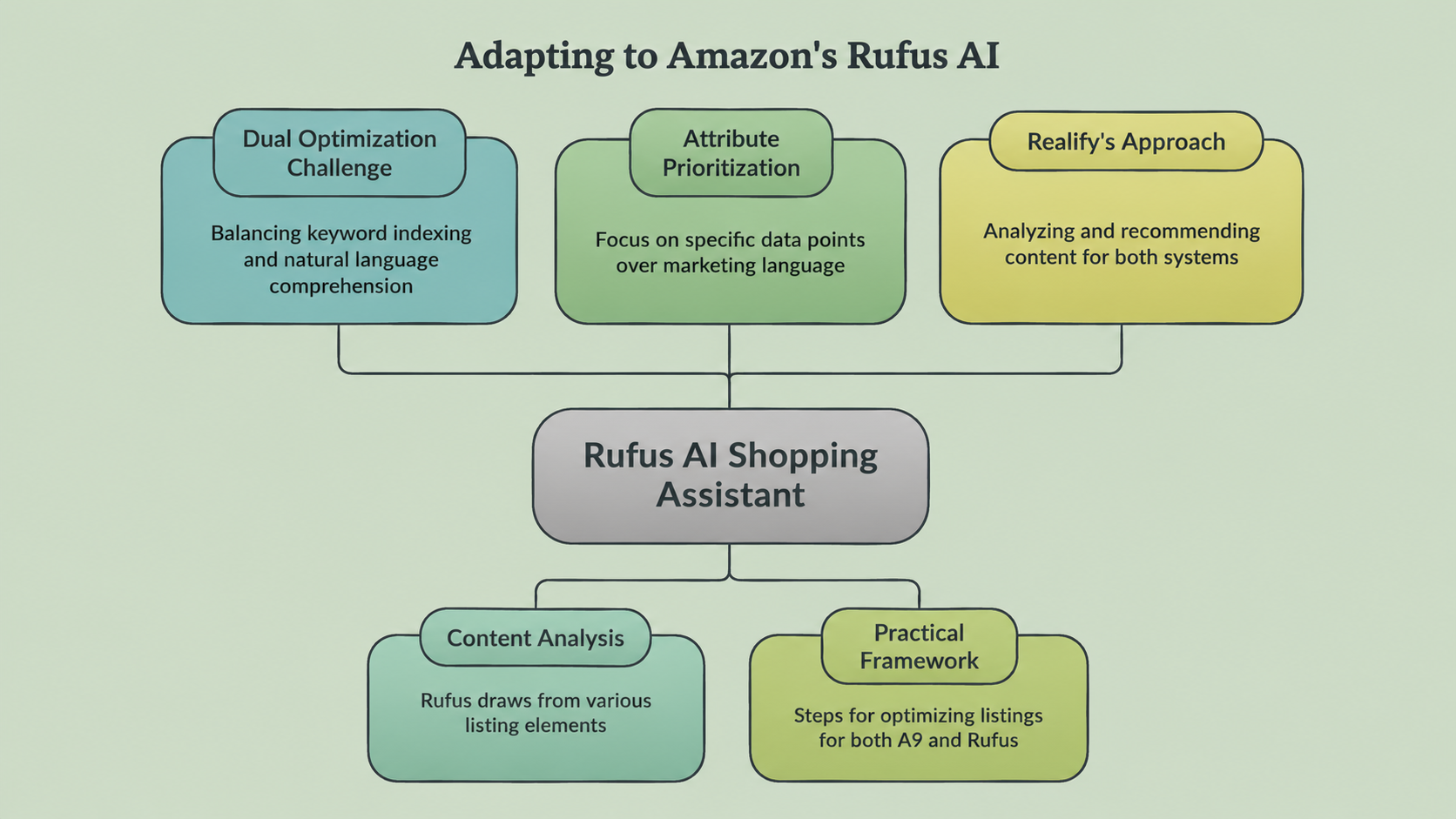
The dual optimization challenge
Before Rufus, listing optimization was primarily a keyword indexing problem. Include the right search terms in your title, bullet points, and backend keywords, and Amazon’s A9 algorithm would surface your product for relevant queries. The optimization was technical: keyword placement, search volume analysis, and relevance matching.
Rufus introduces a second optimization surface: natural language comprehension. Rufus doesn’t just match keywords. It interprets intent and evaluates whether a listing’s content answers the shopper’s question. A listing that ranks well for “wireless headphones” in A9 might not be surfaced by Rufus for “what headphones are best for running in the rain?” unless the listing content explicitly addresses use cases, environmental conditions, and functional attributes in a way that Rufus’s language model can parse.
The two systems don’t compete. They compound. A listing that indexes well in A9 and reads clearly for Rufus captures both discovery surfaces. A listing that optimizes for one while neglecting the other leaves traffic on the table [2].
What Rufus reads (and what it ignores)
Based on observed Rufus behavior and Amazon’s documentation, the AI assistant draws from: product titles (for category and basic identification), bullet points (for feature and benefit parsing), product descriptions and A+ content (for detailed attribute understanding), customer reviews (for real-world validation of claims), Q&A sections (for specific question-answer pairs), and product specifications/attribute fields (for structured data).
Rufus prioritizes content that answers questions directly. A bullet point that reads “40-hour battery life” is more useful to Rufus than one that reads “Long-lasting battery for all-day use.” The first provides a specific, parseable data point. The second is marketing language that doesn’t answer any specific query.
This doesn’t mean marketing language is dead. It means it needs to coexist with specific, attributive language. The best Rufus-optimized listings lead each bullet point with a concrete attribute and follow with a benefit statement: “40-hour battery life, enough for a week of daily commutes without recharging.”
Practical optimization framework
For sellers adapting their listing strategy, here’s a framework that works for both A9 and Rufus:
Start with keyword research using your existing tools, identify the high-volume search terms your product should index for. Then, for each keyword cluster, identify the questions a shopper might ask that would lead to that search. “Wireless headphones” maps to questions like: “What are the best wireless headphones under $50?” “Are wireless headphones good for running?” “How long do wireless headphones last?”
Structure your listing content to answer these questions explicitly. Each bullet point should: include a high-value keyword (A9 optimization), state a specific attribute or data point (Rufus optimization), and connect the attribute to a use case or benefit (shopper conversion).
How Realify approaches listing intelligence
Realify’s listing intelligence capability analyzes your catalog against both keyword indexing and natural language comprehension signals. It identifies gaps where your listings index well for keywords but lack the specific, attributive content that Rufus surfaces, and recommends content additions that address both surfaces simultaneously.
The system also monitors competitor listings to identify which products Rufus is surfacing for high-intent queries in your category, and what content attributes those listings have that yours may lack. This competitive listing intelligence helps you understand not just what keywords to target, but what questions to answer.
As Amazon’s product discovery increasingly involves AI-mediated shopping, listing optimization evolves from a keyword problem to a content strategy problem. The sellers who adapt their listings to speak to both the algorithm and Rufus will capture disproportionate share of the discovery surface.
- •[1] Amazon Rufus AI assistant documentation and observed behavior, 2024-2025.
- •[2] A leading seller analytics platform, “The Next Generation of Amazon Product Page Optimization,” 2026, addressing dual A9/Rufus optimization.