The marketplace fee structure in 2026 is the most comprehensive it has ever been. What was once a straightforward referral fee plus fulfillment charge has evolved into a layered system of over a dozen distinct charges, some visible in your settlement report, others embedded in line items that most sellers never audit.
For a seller doing $500K to $10M annually, the difference between understanding this fee stack and not understanding it can be 5 to 10 percentage points of margin [1]. Here is the complete breakdown.
The fee layers
Layer 1: Referral fees. The marketplace charges a percentage of each sale, varying by category. Most categories fall between 8% and 15%, with the majority at 15%. Media categories (books, music) are lower. Some categories have minimum per-item referral fees. For a $29.99 product in a standard 15% category, the referral fee is $4.50.
Layer 2: Fulfillment fees. Per-unit fulfillment fees depend on product size and weight tier. A standard-size item under 1 lb costs approximately $3.22 to fulfill as of early 2026. Oversize items range from $9.73 to over $150 for special handling. These fees were restructured in 2024-2025, with more granular weight tiers introduced that refined effective fees for items near tier boundaries.
Layer 3: Monthly storage fees. The fulfillment program charges monthly storage based on cubic footage. Standard-size inventory costs $0.87 per cubic foot from January through September and $2.40 per cubic foot during Q4 (October through December). Oversize rates are lower per cubic foot but add up quickly for bulky items.
Layer 4: Aged inventory surcharge. Inventory stored in the fulfillment program for over 181 days incurs a surcharge that increases with age. Items stored 271-365 days are charged $1.50 per cubic foot per month. Items over 365 days face $6.90 per cubic foot per month, a surcharge that can exceed the product’s landed cost.
Layer 5: Inbound placement fees. Introduced in 2024, these fees apply when inventory is distributed across multiple fulfillment centers. Sellers can reduce these fees by shipping to more destinations or using the partnered carrier program, but the default single-destination shipment now carries an inbound placement charge of $0.27 per unit for standard size items [2].
Layer 6: Return processing fees. Sellers are charged for customer returns in certain categories, particularly apparel and shoes. The fee varies by product size but typically runs $2 to $5 per return. With average return rates of 10-20% in some categories, this is a meaningful cost.
Layer 7: Advertising costs. While technically not an Amazon fee, Sponsored Products, Brands, and Display advertising has become a near-requirement for visibility. Average ACOS varies by category but ranges from 15% to 35% for most competitive categories. For a $29.99 product, a 25% ACOS means $7.50 in advertising cost per attributed sale.
Layer 8: SP-API developer fees. New in 2026, third-party developers are now charged a $1,400 annual subscription fee plus monthly GET call volume fees across four tiers. While sellers using private developer accounts for their own business are exempt, sellers using third-party tools may see these costs passed through in higher tool subscription prices [3].
The complete model
For a standard product at $29.99 in a 15% referral fee category, with FBA fulfillment, a 25% ACOS, and a 12% return rate:
| Fee Component | Amount | % of Sale Price |
|---|---|---|
| Referral fee (15%) | $4.50 | 15.0% |
| FBA fulfillment | $3.22 | 10.7% |
| Monthly storage (amortized) | $0.35 | 1.2% |
| Inbound placement | $0.27 | 0.9% |
| Return processing (12% rate x $3.50 avg) | $0.42 | 1.4% |
| Advertising (25% ACOS) | $7.50 | 25.0% |
| Total marketplace cost | $16.26 | 54.2% |
At a $29.99 price point, marketplace-related costs consume over 54% of revenue before your cost of goods. If your landed COGS is 30% of the selling price ($9.00), your gross margin before operational overhead is approximately $4.73, or 15.8% [4].
This is why fee visibility matters so much. A 2% increase in any single fee category, referral, fulfillment, advertising, can cut your margin by a quarter in relative terms.
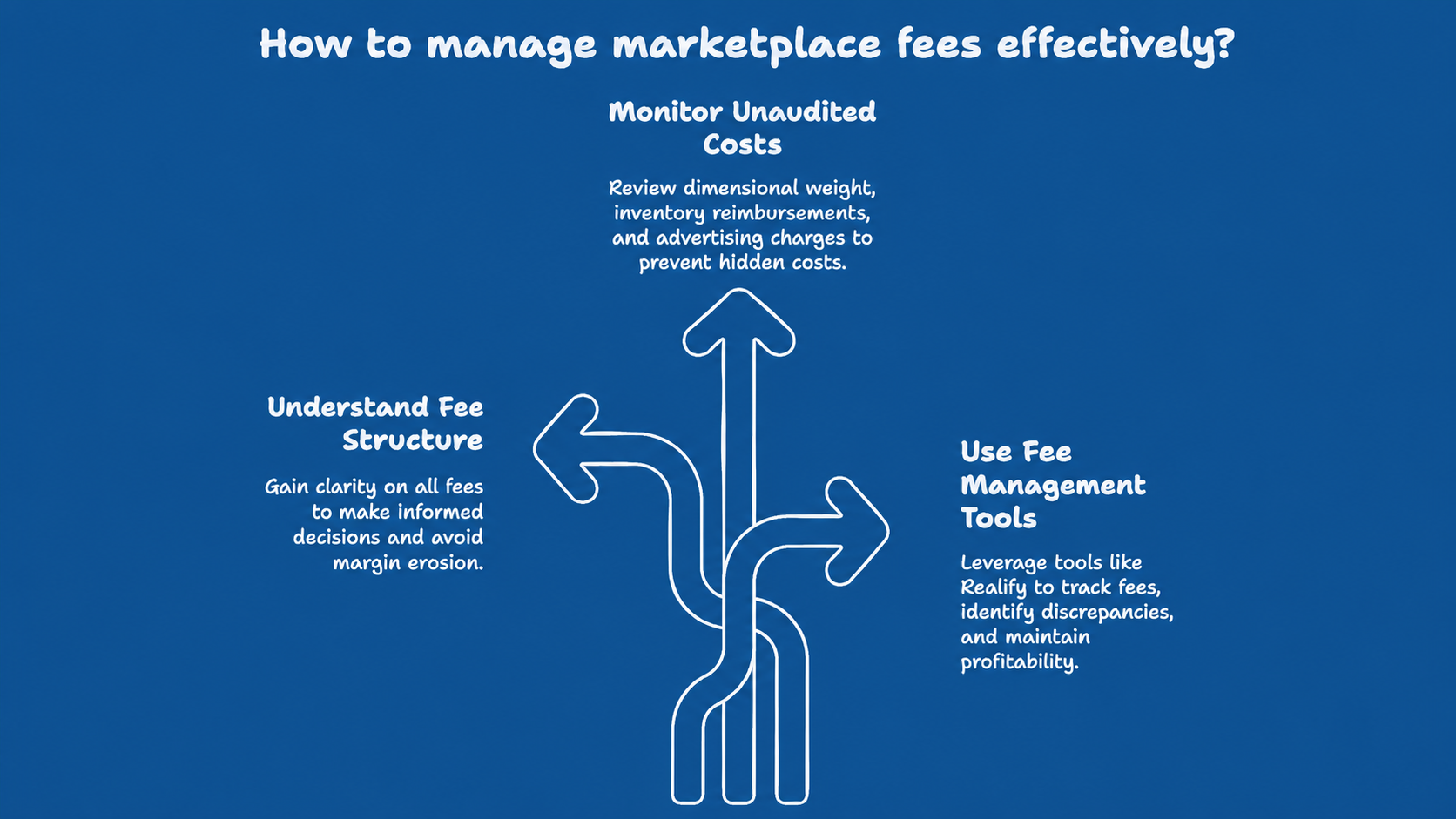
Unaudited cost categories worth reviewing
The charges listed above are those reported clearly in standard settlement reports. But three additional cost categories frequently go unaudited.
First, dimensional weight discrepancies. Products are measured upon receipt at fulfillment centers. If the assigned measurement differs from your own specifications, even by fractions of an inch, your fulfillment fee tier can shift upward. Sellers report measurement discrepancies on 5-15% of ASINs, with rate variances ranging from $0.20 to $2.00+ per unit [5].
Second, lost and damaged inventory reimbursements. Fulfillment program agreements include provisions for reimbursing sellers for inventory lost or damaged within the fulfillment network. Not all eligible events are automatically flagged for reimbursement. Sellers may need to file claims, often with documentation requirements, within specific time windows. Estimates suggest that 1-3% of fulfillment inventory experiences reimbursable events that go unclaimed.
Third, advertising charge inconsistencies. Advertising billing systems can occasionally record charges for clicks or impressions that fall outside the seller’s campaign parameters. While individually small, these inconsistencies compound across thousands of daily clicks.
How Realify addresses fee visibility
Realify’s margin tracking decomposes every sale to the SKU level, calculating CM1 (revenue minus COGS and marketplace fees), CM2 (CM1 minus advertising), and CM3 (CM2 minus operational overhead). This decomposition runs continuously, not as a weekly spreadsheet exercise, and flags when fee changes push any ASIN below its margin threshold.
The system also identifies dimensional weight discrepancies by cross-referencing assigned fees with your product specifications, flagging ASINs where the fee tier doesn’t match the expected dimensions. And it monitors advertising charges against campaign parameters, alerting you to billing anomalies before they accumulate.
Fee management isn’t a one-time audit. It’s an ongoing operational discipline, and one that’s dramatically easier when the system sees all the fees in one place.
- •[1] Canopy Management, “Amazon’s Invisible Challenges: A Strategic Analysis for 2026” – hidden fees cutting 5-10% from margins.
- •[2] Amazon FBA fee schedule, updated January 2026.
- •[3] Amazon SP-API fee announcement, effective January 31, 2026.
- •[4] Model based on published Amazon fee schedules and industry-average ACOS data from Helium 10 and Jungle Scout reports.
- •[5] Seller-reported dimensional weight discrepancy rates from Amazon Seller Central forums and FBA reimbursement service providers.