The Amazon Buy Box, the “Add to Cart” button that defaults to one seller on a shared listing, drives over 82% of Amazon purchases [1]. Winning it is the single most consequential operational outcome for any Amazon seller. Losing it means your offer is buried behind an “Other Sellers on Amazon” link that fewer than 18% of shoppers ever click.
Despite its importance, the Buy Box algorithm remains Amazon’s most consequential black box. Amazon doesn’t publish the formula. What we know comes from observed patterns, seller experimentation, and the rare official guidance Amazon provides.
Here’s what the data tells us about Buy Box determination in 2026.
The known factors
Price is the most visible factor but not the only one, or even the most important. Amazon evaluates what it calls the “landed price”: the product price plus shipping cost. For FBA sellers, shipping is typically Prime-eligible, which gives an inherent advantage. But two FBA sellers at the same price won’t share the Buy Box equally. The algorithm considers additional factors.
Fulfillment method matters significantly. FBA sellers have a structural advantage over FBM (Fulfilled by Merchant) sellers because Amazon trusts its own logistics to meet delivery promises. Among FBM sellers, those with Seller Fulfilled Prime status compete more effectively than standard FBM sellers.
Seller performance metrics, Order Defect Rate, Late Shipment Rate, and Pre-fulfillment Cancel Rate, create eligibility thresholds. A seller whose Order Defect Rate exceeds 1% is unlikely to win the Buy Box at any price. These metrics function as gates rather than continuous variables: you’re either eligible or you’re not.
Inventory availability influences Buy Box rotation. A seller approaching stockout may see reduced Buy Box allocation as Amazon’s algorithm hedges against unfulfillable orders. This creates a perverse dynamic: the seller most in need of sales (because they’re running low on stock) gets less Buy Box exposure, while the seller with deep inventory gets more.
Shipping speed, even among Prime-eligible offers, creates differentiation. A seller offering one-day delivery from a nearby fulfillment center may earn more Buy Box rotation than a seller offering two-day delivery, even at an identical price [2].
Why it’s an operations problem
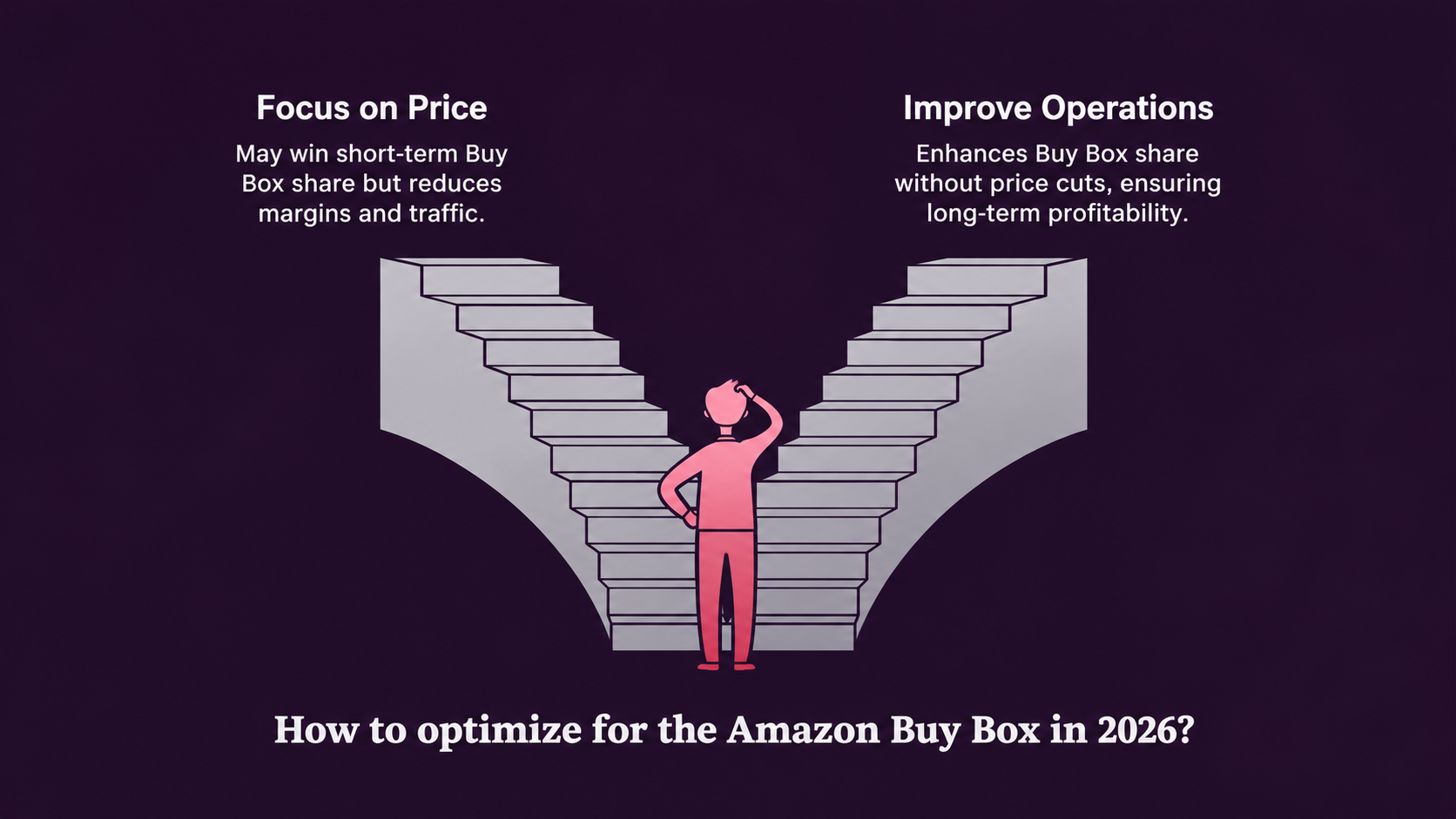
Most sellers approach Buy Box optimization as a pricing problem: lower the price, win more Buy Box. This works in the short term and fails structurally.
The Buy Box is an operations problem because every factor the algorithm evaluates, price, fulfillment method, performance metrics, inventory depth, and shipping speed, is an operational outcome. And these outcomes interact with each other in ways that pure pricing tools don’t account for.
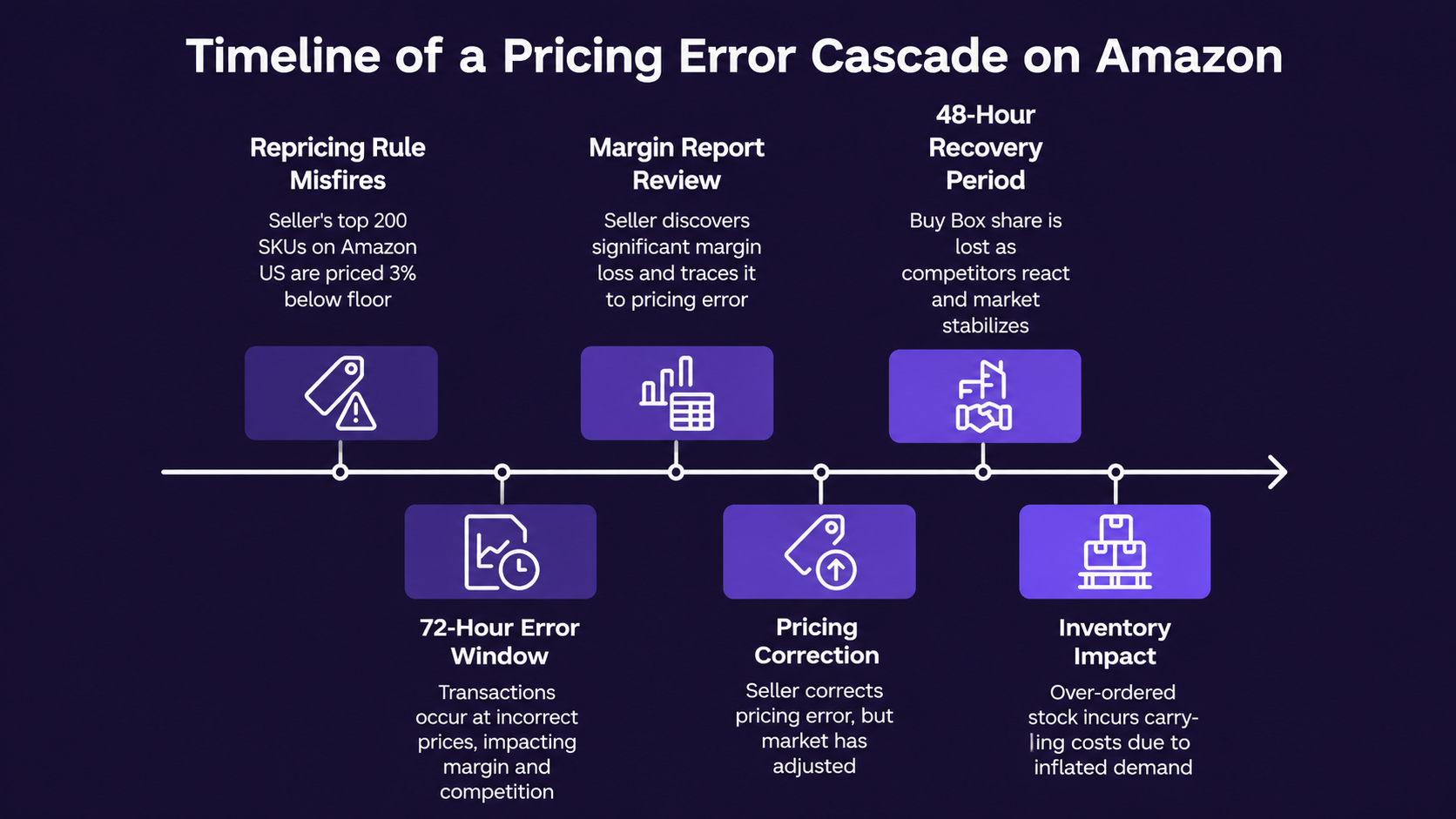
Lowering your price wins Buy Box share in the short term but reduces margin. Reduced margin constrains advertising budget. Reduced advertising budget lowers traffic. Lower traffic reduces velocity. Reduced velocity increases per-unit storage costs as inventory ages. The Buy Box win was real. The business impact was negative.
Conversely, improving inventory positioning across Amazon’s fulfillment network, ensuring stock is distributed to fulfill one-day and same-day delivery, can improve Buy Box share without touching price. Maintaining strong seller performance metrics creates a floor of Buy Box eligibility that competitors can’t undercut with price alone. And keeping inventory depth healthy prevents the algorithmic penalty that comes with approaching stockout.
Realify’s approach to Buy Box optimization
Because Buy Box determination involves pricing, inventory, fulfillment, and performance metrics simultaneously, optimizing for it requires a system that sees all four domains.
Realify evaluates Buy Box competitiveness holistically. Before recommending a price adjustment, the system checks: Is your inventory depth sufficient to sustain the velocity a lower price would generate? Is your seller performance score strong enough to compete at this price point? Would the margin at the proposed price support your current advertising investment on this ASIN? Are there non-price factors (inventory distribution, shipping speed) that could improve Buy Box share without a price reduction?
This cross-domain analysis is what distinguishes an operating system approach from a repricing tool approach. The repricing tool asks: “What price wins the Buy Box?” Realify asks: “What combination of price, inventory, and operational execution maximizes Buy Box value, meaning not just win rate, but profitability per Buy Box impression?”
The distinction matters most for sellers in competitive categories where the Buy Box is contested among multiple qualified sellers. In these categories, the seller with the best operational posture, not just the lowest price, wins the most profitable Buy Box share over time.
- •[1] Buy Box share of sales estimated at 82%+ based on industry analyses by Feedvisor, Jungle Scout, and marketplace analytics platforms, 2024-2025.
- •[2] Fulfillment speed and inventory distribution effects on Buy Box documented by Amazon seller community experimentation and third-party seller management case studies, 2025.