Every Amazon seller knows Q4 matters. Fewer know that Q4 outcomes are largely determined by decisions made in July through September. By the time October arrives, your inventory is committed, your advertising budgets are allocated, and your pricing strategy is constrained by positions you took months earlier.
Here’s the operational timeline that separates sellers who thrive in Q4 from those who merely survive it.
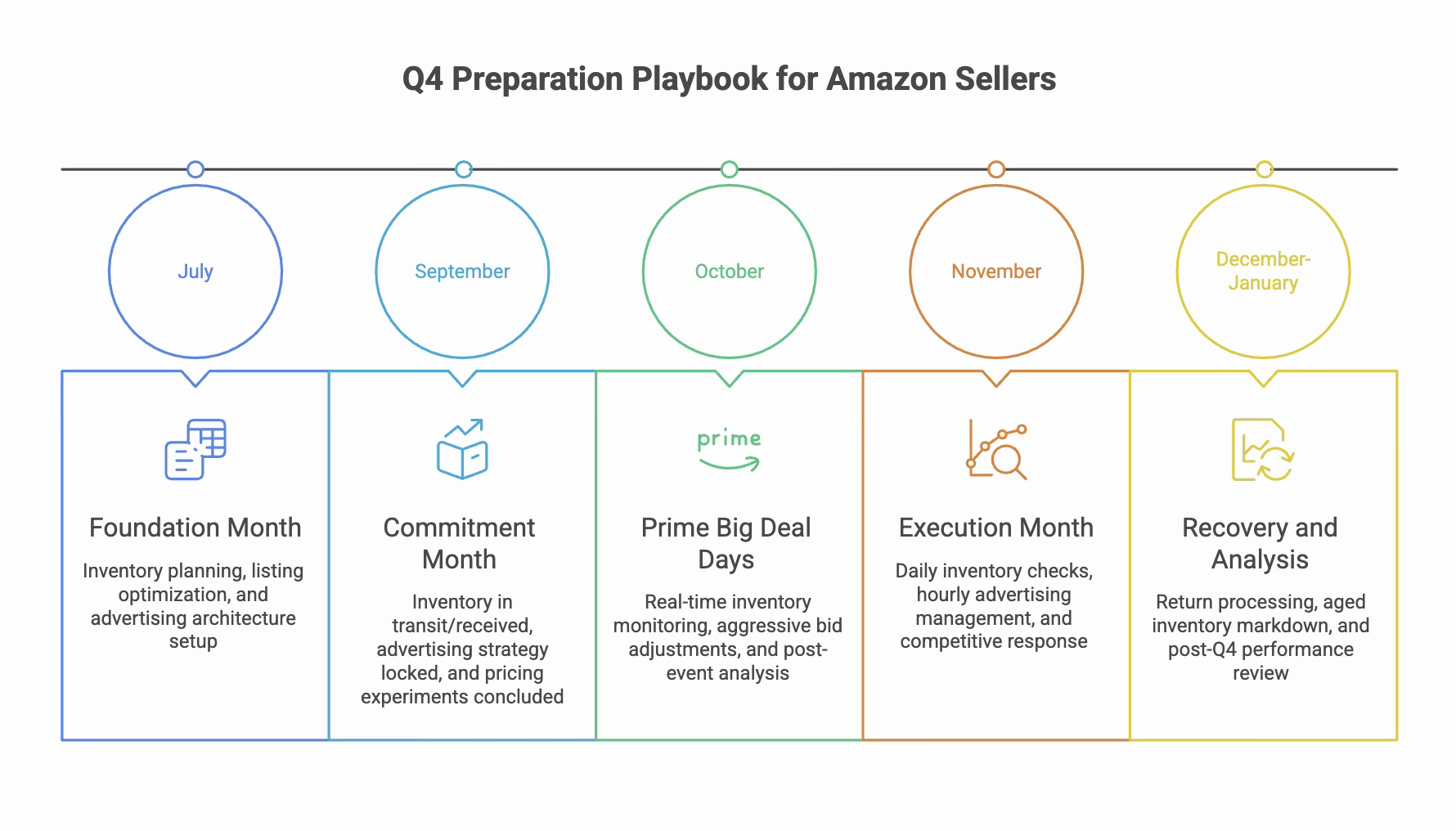
July: Foundation month
Q4 preparation begins in July with three critical decisions.
First, inventory planning. Analyze your Q4 from the previous year: which ASINs spiked, by how much, and starting when? Layer in category trends, competitive changes since last year, and any advertising investments you’re planning that will drive incremental demand. Then calculate your inbound shipment schedule, working backward from FBA receiving timelines (which extend to 2-3 weeks during peak intake periods in September-October) [1].
The inventory decision in July is the single most consequential Q4 decision. Ordering too little means stockouts during the highest-revenue weeks. Ordering too much means aged inventory surcharges and capital trapped in slow-moving stock. The margin for error is narrow, and the feedback loop is long. You won’t know if you ordered correctly until November.
Second, listing optimization. Q4 is not the time to experiment with listing content. Audit your top 50 revenue-generating ASINs in July: title compliance with Amazon’s current style guide, bullet point quality, A+ content completeness, image count and quality, and review profile. Fix everything before September, because listing changes during Q4 can temporarily affect ranking while the algorithm reindexes.
Third, advertising architecture. Build your Q4 campaign structure in July. This means: creating campaign shells for Prime Big Deal Days (October) and Black Friday/Cyber Monday (November) with proper targeting, establishing baseline bid levels on your top keywords, and setting up dayparting and budget rules for peak traffic periods.
September: Commitment month
By September, inventory should be in transit or received at FBA. If your inventory plan was sound in July, September is about confirming receipt and making final adjustments.
September is also when you lock advertising strategy. Review your Sponsored Products, Brands, and Display campaigns. Confirm that your budget can sustain daily spend through November without exhausting mid-day during peak traffic hours. Set up automated budget rules that increase daily caps during Prime Big Deal Days and BFCM.
Critically, September is the last opportunity to run pricing experiments before the Q4 freeze. Test any price changes you’re considering for Q4 now. Don’t experiment with pricing during your highest-revenue period.
October: Prime Big Deal Days
Amazon’s October Prime event has become a significant revenue driver. A leading seller management firm reported 18% growth in Prime Big Deal Days revenue for their managed brands, driven by advance preparation, not reactive participation [2].
Your operational focus during Prime Big Deal Days: monitor inventory velocity in real-time (stockouts during a 48-hour event are unrecoverable), adjust advertising bids aggressively during the event window (CPCs spike but conversion rates spike more), and track promotional performance against plan.
Post-event, immediately analyze: which ASINs overperformed (potential Q4 winners needing additional inventory), which underperformed (potential markdowns), and what the advertising efficiency looked like versus baseline.
November: Execution month
Black Friday through Cyber Monday is the peak of the Amazon selling year. Your operational priorities narrow to three things.
Inventory monitoring: Check stock levels daily. If an ASIN is trending toward stockout, decide immediately whether to raise price (preserving remaining inventory for higher margin) or maintain price (maximizing revenue at the risk of stockout). This decision requires margin and inventory data in the same view, exactly the cross-domain visibility that Realify provides.
Advertising management: Monitor hourly during BFCM. CPCs can double during peak hours. Pause underperforming campaigns quickly and reallocate budget to top converters. Adjust dayparting to concentrate spend during highest-conversion windows (typically 6-10 PM EST).
Competitive response: During BFCM, competitors make aggressive pricing moves. Your response should be governed by your margin floor, not by competitive matching instinct. A competitor running a loss-leader on your top ASIN is not a signal to match. It’s a signal to let them burn inventory while you maintain profitable pricing.
December-January: Recovery and analysis
Post-Q4 operations matter more than most sellers realize. December 26 through January 15 is the return processing window. Customer returns spike, and your margin from Q4 sales adjusts retroactively. Monitor return rates by ASIN and investigate any anomalies.
January is also when aged inventory surcharges begin accruing on Q4 overstock. If you over-ordered, the first two weeks of January are your window to markdown, remove, or liquidate before storage costs compound.
How Realify supports Q4 operations
Realify’s value during Q4 is the convergence of everything it does the rest of the year, but under time pressure. Pricing intelligence adjusts in real-time as competitors make BFCM moves, within your margin guardrails. Inventory monitoring tracks velocity against your Q4 plan and flags stockout risks before they materialize. Advertising optimization reallocates budget across campaigns based on hourly performance during peak events. And the forecasting capability projects post-Q4 inventory positions, helping you avoid the January surcharge trap.
Q4 is when the operating system thesis proves itself. The seller running seven disconnected tools simply cannot operate at the speed Q4 demands. The seller with one system that sees everything simultaneously can.
- •[1] Amazon FBA receiving timelines and Q4 inventory guidance, Seller Central documentation, 2025-2026.
- •[2] A leading seller management firm, “18% Prime Big Deal Days Growth,” October 2025.