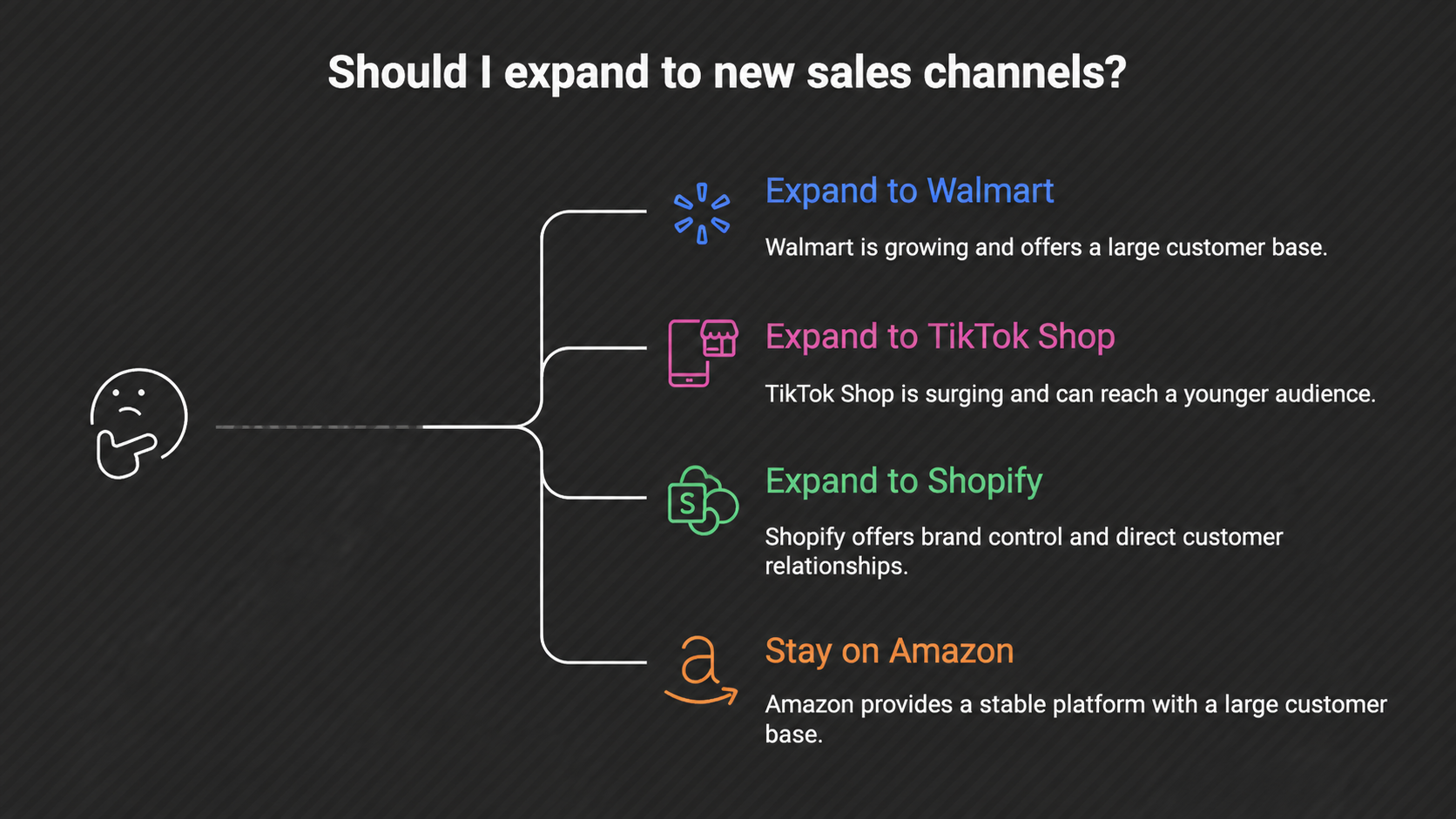
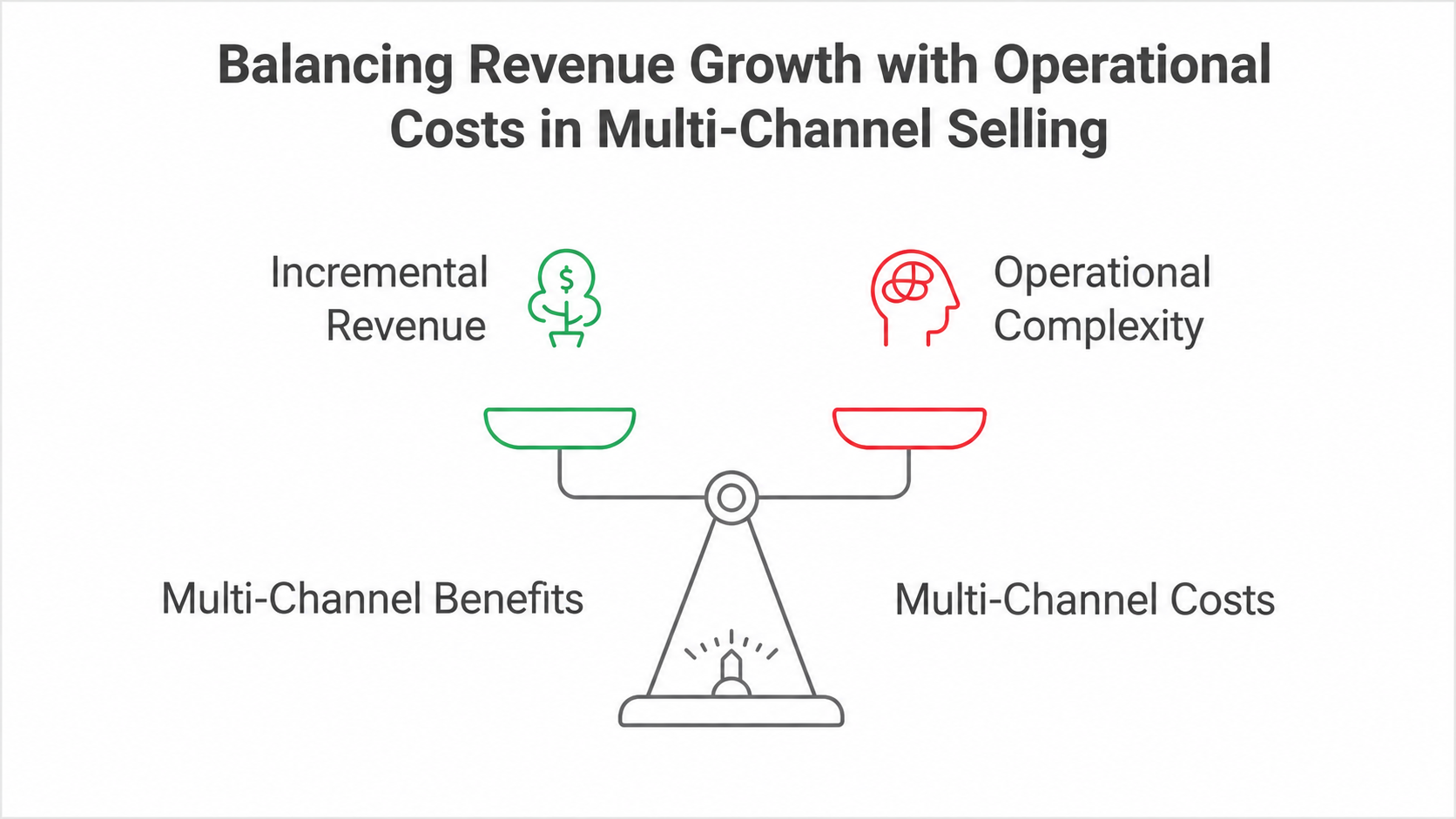
The pitch for multi-channel selling is intuitive. Amazon gives you access to 200+ million Prime members. Shopify gives you a branded D2C presence. Walmart gives you a growing marketplace with lower competition. TikTok Shop gives you a social commerce audience. Each channel represents incremental revenue. Add them together and your business grows.
The reality is more complicated. Every channel you add doesn’t just add revenue. It adds operational surface area. And that surface area has costs that most sellers don’t measure until they’re already deep into them.
The visible costs
The direct financial cost of multi-channel operations is straightforward to calculate. Each channel comes with: a platform subscription or listing fee, marketplace-specific advertising spend, fulfillment infrastructure (FBA for Amazon, WFS for Walmart, third-party for Shopify), channel-specific tools and integrations, and compliance requirements (category approvals, brand registry, product documentation).
For a seller expanding from Amazon US to Shopify and Walmart, the incremental visible cost is typically $2,000 to $5,000 per month in subscriptions, tools, and platform fees, manageable for a business doing $1M+ annually [1].
The invisible costs
It’s the invisible costs that compound. And they fall into three categories that most sellers don’t track separately.
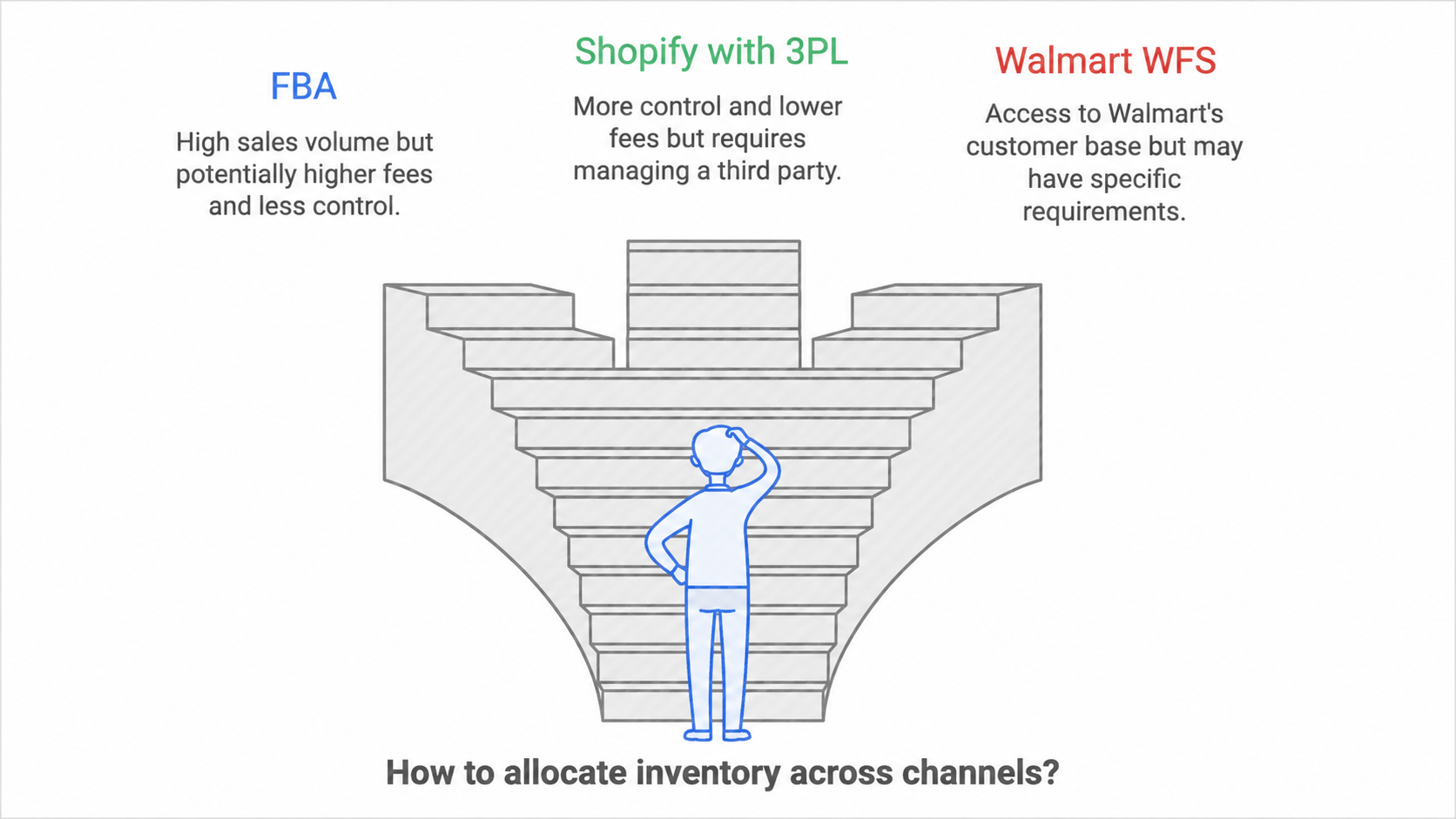
The first invisible cost is inventory fragmentation. When you sell the same product across multiple fulfillment channels, including a primary marketplace fulfillment program, your own warehouse, and additional marketplace fulfillment services, you’re splitting inventory across multiple pools. Each pool has different economics: each fulfillment program carries its own storage costs and per-order fulfillment rates. The allocation decision, how much inventory goes where, is a continuous optimization problem that most sellers solve by instinct rather than analysis.
The consequences of poor allocation are asymmetric. Over-allocating to one channel means customers on other channels face longer shipping times or stockouts. Under-allocating to a primary marketplace means losing Buy Box share and advertising efficiency during peak periods.
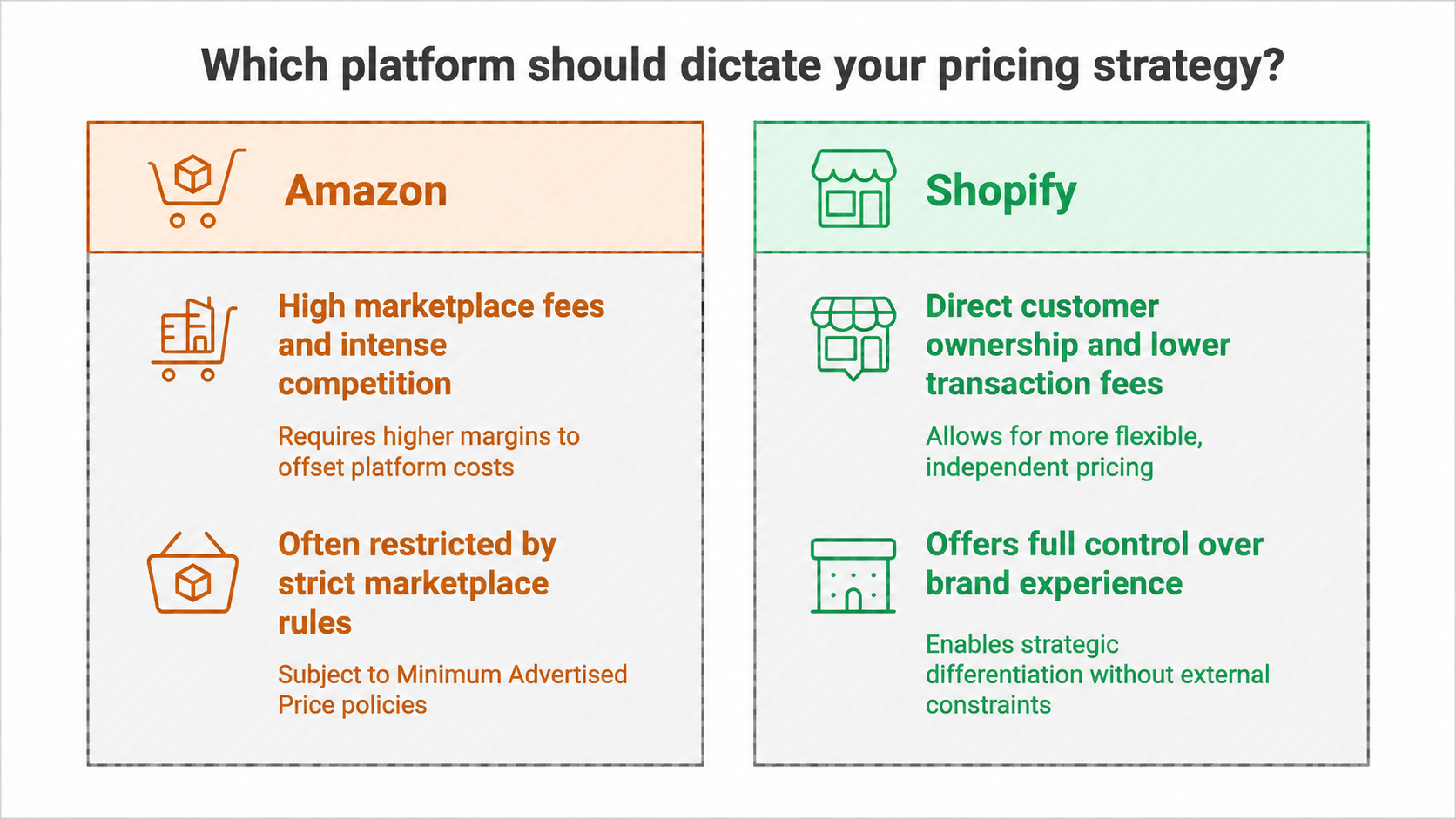
The second invisible cost is pricing reconciliation. Different channels have different fee structures, which means the same gross price yields different net margins. A product priced at $29.99 on Amazon (with 15% referral + $3.22 FBA fees) and $29.99 on Shopify (with 2.9% + $0.30 payment processing) has dramatically different unit economics. Yet most sellers maintain identical pricing across channels, either by default or because their brand’s MAP policy requires it, without adjusting other variables (advertising spend, fulfillment method) to account for the margin differential.
The third invisible cost is operational attention fragmentation. Every channel has its own dashboard, its own notification system, its own performance metrics, and its own customer service requirements. A seller operating across three channels isn’t managing three versions of the same business. They’re managing three businesses with different rules, and the mental switching cost between them reduces the quality of decisions across all three.
Quantifying the tax
Here’s a simplified model for a seller doing $3M annually on Amazon who expands to Shopify ($500K) and Walmart ($300K).
Additional tool subscriptions and platform fees: $3,000/month ($36,000/year). Inventory carrying cost from sub-optimal allocation (estimated 5% of multi-channel inventory value): $19,000/year. Operational time for cross-channel reconciliation (10 hours/week at $75/hour blended cost): $39,000/year. Advertising inefficiency from non-coordinated cross-channel campaigns (estimated 8% waste): $9,600/year on $120K total ad spend.
Total multi-channel tax: approximately $103,600/year, or 2.7% of total revenue. For a business operating at 15% net margin, that’s 18% of profit consumed by operational fragmentation.
Reducing the tax
The multi-channel tax is not inevitable. It’s a function of how you operate, not what channels you’re on. Sellers who manage channels through an integrated operating system, where inventory, pricing, advertising, and reporting share a single data layer, eliminate most of the reconciliation cost and significantly reduce the allocation and efficiency costs.
Realify is built specifically for this problem. When you connect Amazon, Shopify, and Walmart to Realify, inventory allocation optimizes across all three channels simultaneously, accounting for each channel’s fee structure, demand patterns, and fulfillment economics. Pricing decisions account for channel-specific margin profiles. Advertising performance is visible across all platforms in one view, enabling portfolio-level budget optimization.
The result isn’t that multi-channel operations become free. It’s that the operational overhead scales sub-linearly with channel count, adding a fourth channel doesn’t double the complexity because the system is already designed for cross-channel coordination.
The sellers who win at multi-channel aren’t the ones who add the most channels. They’re the ones who add channels without proportionally adding operational burden.
- •[1] Estimated based on published pricing for Shopify Plus ($2,300/mo), Walmart Marketplace fees, and multi-channel tool subscriptions.