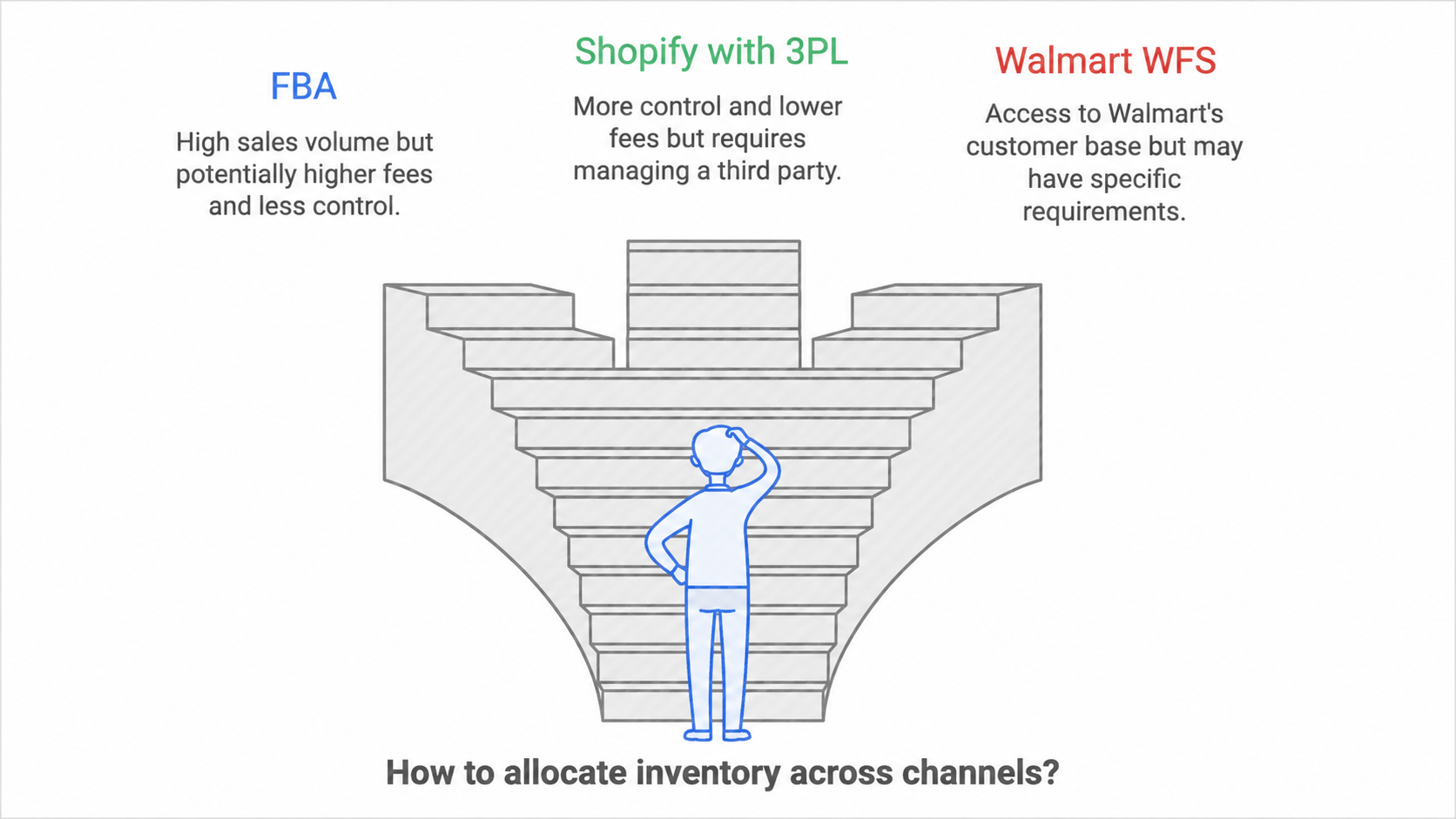
The most consequential decision most multi-channel sellers make is one they rarely think about explicitly: how to divide their inventory across channels and fulfillment methods.
A seller with 1,000 units of a product and three active channels (Amazon FBA, Shopify via 3PL, and Walmart WFS) must decide: how many units go to FBA? How many to the 3PL? How many to WFS? The answer determines their stockout risk on each channel, their total storage cost, their fulfillment speed (and therefore their competitiveness), and their working capital efficiency.
Most sellers solve this problem with rules of thumb: “70% to FBA because that’s where most sales happen.” These rules work until they don’t, and they tend to fail at exactly the moments when getting the allocation right matters most.
Why static allocation fails
Static allocation, sending the same percentage to each channel every reorder cycle, ignores the dynamic relationship between demand, seasonality, and competitive conditions across channels.
During Q4, Amazon demand may spike 3x while Shopify demand spikes 1.5x. A static 70/20/10 allocation sends too much inventory to channels with lower seasonal uplift and not enough to channels with higher uplift. The result: FBA stockouts during peak Amazon demand and excess inventory at the 3PL.
The reverse happens post-Q4: Amazon demand normalizes while returns flood back into FBA, effectively increasing your FBA inventory position beyond what demand supports. Meanwhile, the 3PL inventory that was excess during Q4 now represents your fastest-moving stock as Q1 Shopify demand stabilizes.
Dynamic allocation, adjusting the split based on current velocity, forecasted demand, storage costs, and fulfillment economics, is the correct approach but nearly impossible to execute manually across three channels with different data systems.
The allocation variables
A proper allocation model considers: current sell-through rate on each channel, forecasted demand for the next reorder cycle (accounting for seasonality and promotions), storage cost per unit per day at each fulfillment location, fulfillment cost per order from each location, lead time from supplier to each fulfillment destination, and the minimum stock threshold needed to maintain competitive positioning (Buy Box eligibility on Amazon, delivery speed promises on Shopify).
When these variables are visible in one system, as they are in Realify, the allocation decision transforms from a gut-feel estimate to a calculated optimization. Realify’s inventory capability models the total cost of ownership across all fulfillment locations and recommends allocation splits that minimize total cost while maintaining competitive service levels on every channel.
- •Based on multi-channel inventory management best practices documented across Amazon FBA, Walmart WFS, and major 3PL operational guides, 2025-2026.