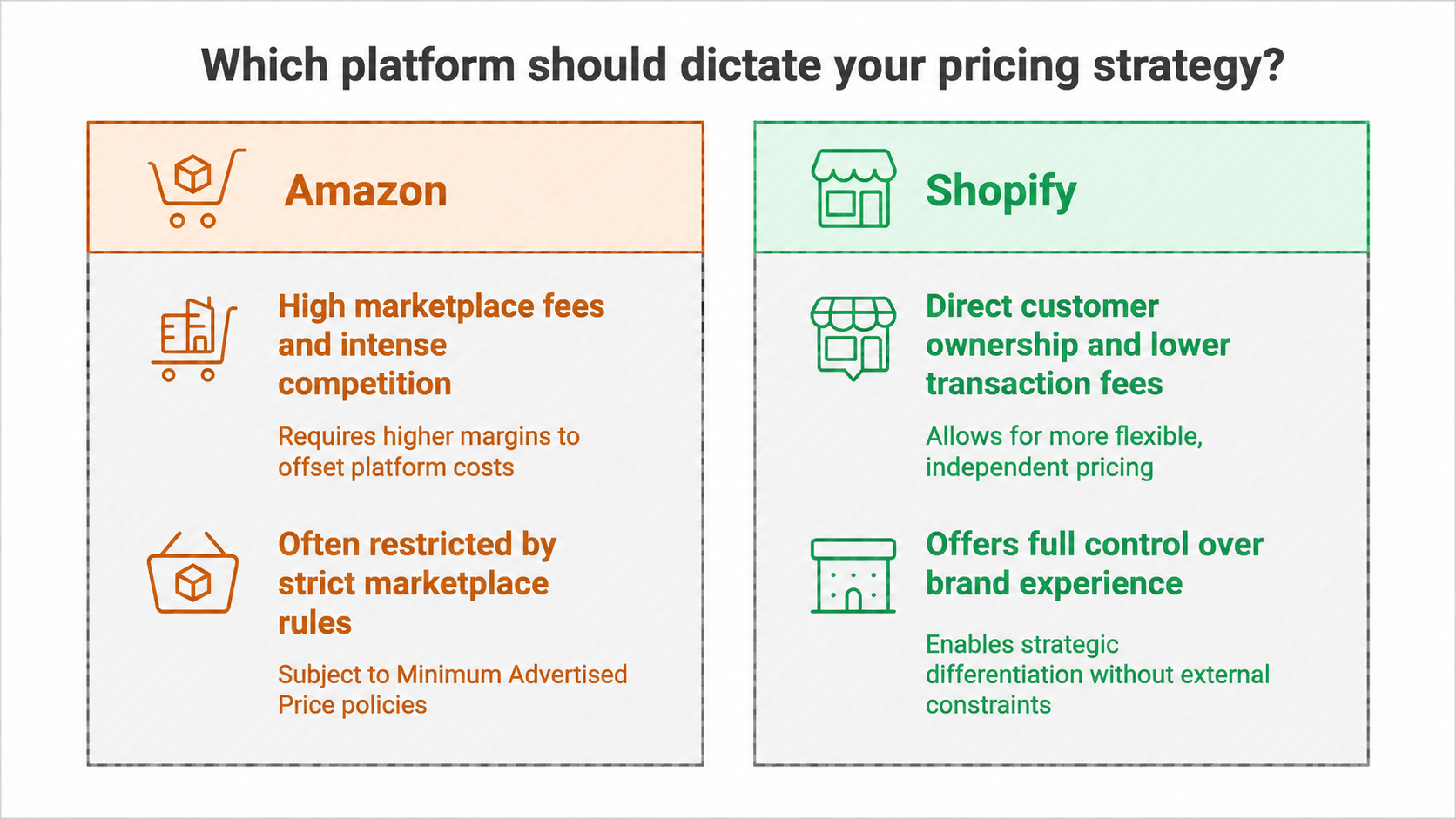
The default assumption for most multi-channel sellers is price parity: the same product costs the same whether a customer buys it on Amazon, Shopify, or Walmart. This feels fair. It simplifies operations. And for sellers with MAP (Minimum Advertised Price) policies, it may be contractually required.
But price parity across channels with different economics is a margin decision hiding as a simplicity decision. And for sellers not bound by MAP, it’s often the wrong one.
The economics of channels differ dramatically
Consider a product priced at $39.99 across Amazon and Shopify.
On Amazon: 15% referral fee ($6.00) + FBA fulfillment ($3.50) + advertising at 25% ACOS ($10.00) = $19.50 in channel costs, or 48.8% of revenue.
On Shopify: 2.9% payment processing ($1.16) + $0.30 per transaction + 3PL fulfillment ($5.00) + advertising at $12 CAC ($12.00) = $18.46 in channel costs, or 46.2% of revenue.
The margin differential is 2.6 percentage points, meaningful but modest at this price point. However, the composition is very different. Amazon’s costs are weighted toward platform fees (which are fixed percentages). Shopify’s costs are weighted toward customer acquisition (which you control).
This means that on a D2C channel, a seller can improve margin by investing in organic traffic, email marketing, and customer retention. On marketplace channels, the margin lever is primarily operational efficiency: reducing advertising cost, optimizing fulfillment, and maintaining competitive positioning without sacrificing profitability.
When differentiation makes sense
For sellers without MAP obligations, strategic price differentiation can improve blended margin without damaging brand perception.
Offering a modest discount on your D2C site (e.g., $37.99 vs. $39.99 on Amazon) incentivizes customers to buy direct, where your margin is better. This is standard practice among leading DTC brands and thousands of direct sellers who view Amazon as a discovery channel and their own site as the higher-margin conversion channel.
Offering a slightly higher price on a channel where you have competitive advantages (strong reviews, Prime eligibility, high Buy Box win rate) can improve unit margin without significantly affecting velocity, particularly for branded products where the customer has already decided to buy your product, not just any product in the category.
How Realify handles cross-channel pricing
Realify’s pricing intelligence operates at the channel level. When you set a margin target, the system calculates the optimal price on each channel independently, accounting for that channel’s fee structure, competitive landscape, and demand elasticity. The result might be identical prices across channels (if that’s what the math supports) or differentiated prices (if the margin math favors it).
If you’re bound by MAP, Realify enforces price floors across all channels while optimizing other margin levers, advertising efficiency, fulfillment cost, and inventory allocation, to maximize profitability within the pricing constraint.
- •Fee calculations based on published Amazon referral fee schedule, Shopify payment processing terms, and industry-average customer acquisition costs, 2025-2026.