Every seller considering autonomous automation has the same concern: “What if it does something I wouldn’t have done?” This isn’t irrational. It’s the appropriate response to delegating consequential decisions to a system you don’t fully understand.
The commerce software industry has largely failed to address this concern. Most tools offer a binary choice: manual control (you make every decision) or full automation (the algorithm makes every decision). Neither is appropriate for high-stakes operations. Manual control doesn’t scale. Full automation doesn’t earn trust.
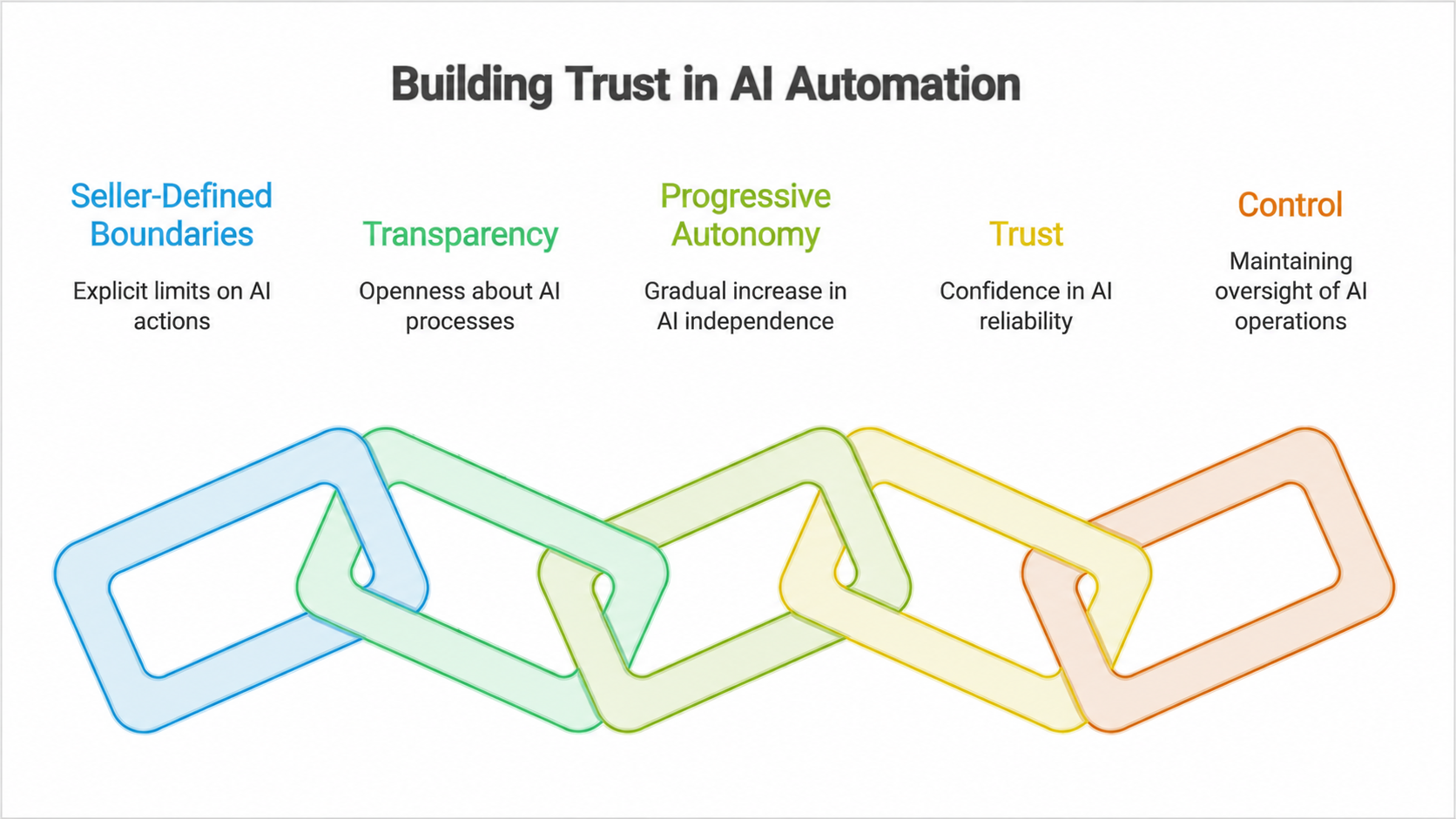
The answer is guardrails, explicit, seller-defined boundaries that constrain what the system can do autonomously.
What guardrails look like in practice
A guardrail is a parameter that defines the operating boundary for an automated action. Guardrails are not goals. They’re constraints. The goal might be “maximize margin.” The guardrails define how far the system can go in pursuit of that goal.
Pricing guardrails might include: never price below $X (absolute floor), never change price by more than Y% in a single adjustment (rate limit), never reprice more than Z times per day on the same ASIN (frequency limit), and never price below a specified margin threshold (margin floor).
Advertising guardrails might include: never increase daily budget by more than 20% in a single day, never bid above $X on any keyword, pause any campaign whose 7-day ACOS exceeds Y%, and never activate a campaign on an ASIN with fewer than Z units in stock.
Inventory guardrails might include: never recommend a reorder quantity exceeding X units (capital constraint), flag any reorder recommendation that would put total inventory above Y days of coverage, and alert when any ASIN drops below Z days of coverage.
Each guardrail is a line the system cannot cross without human approval. The more guardrails, the more constrained the system. Fewer guardrails, more autonomy. The seller calibrates this balance over time based on their experience with the system’s judgment.
How Realify implements guardrails
During onboarding, Realify helps you define guardrails across every operational domain. These aren’t hidden settings. They’re prominently displayed and easily adjustable. Every automated action the system takes is checked against your guardrails before execution. If an action would exceed a guardrail, it enters your review queue instead of executing.
Over time, as you see the system consistently making decisions you agree with, you can widen guardrails, giving the system more room to operate while maintaining the constraints that matter most. If the system ever makes a decision you disagree with, tightening a guardrail takes one click.
The result is a system that earns trust through demonstrated judgment, not marketing promises. And a seller who progressively reclaims time from operational decisions while maintaining strategic control.
- •Based on guardrail architectures documented in autonomous systems design (automotive, financial services, logistics), 2020-2025.