The word “AI” appears on the marketing page of virtually every commerce tool available today. Repricing tools are “AI-powered.” Inventory tools use “machine learning.” Advertising platforms offer “intelligent optimization.” The language is everywhere. The substance varies dramatically.
To cut through the noise, it helps to understand the spectrum of automation capability in commerce and where the industry is heading.
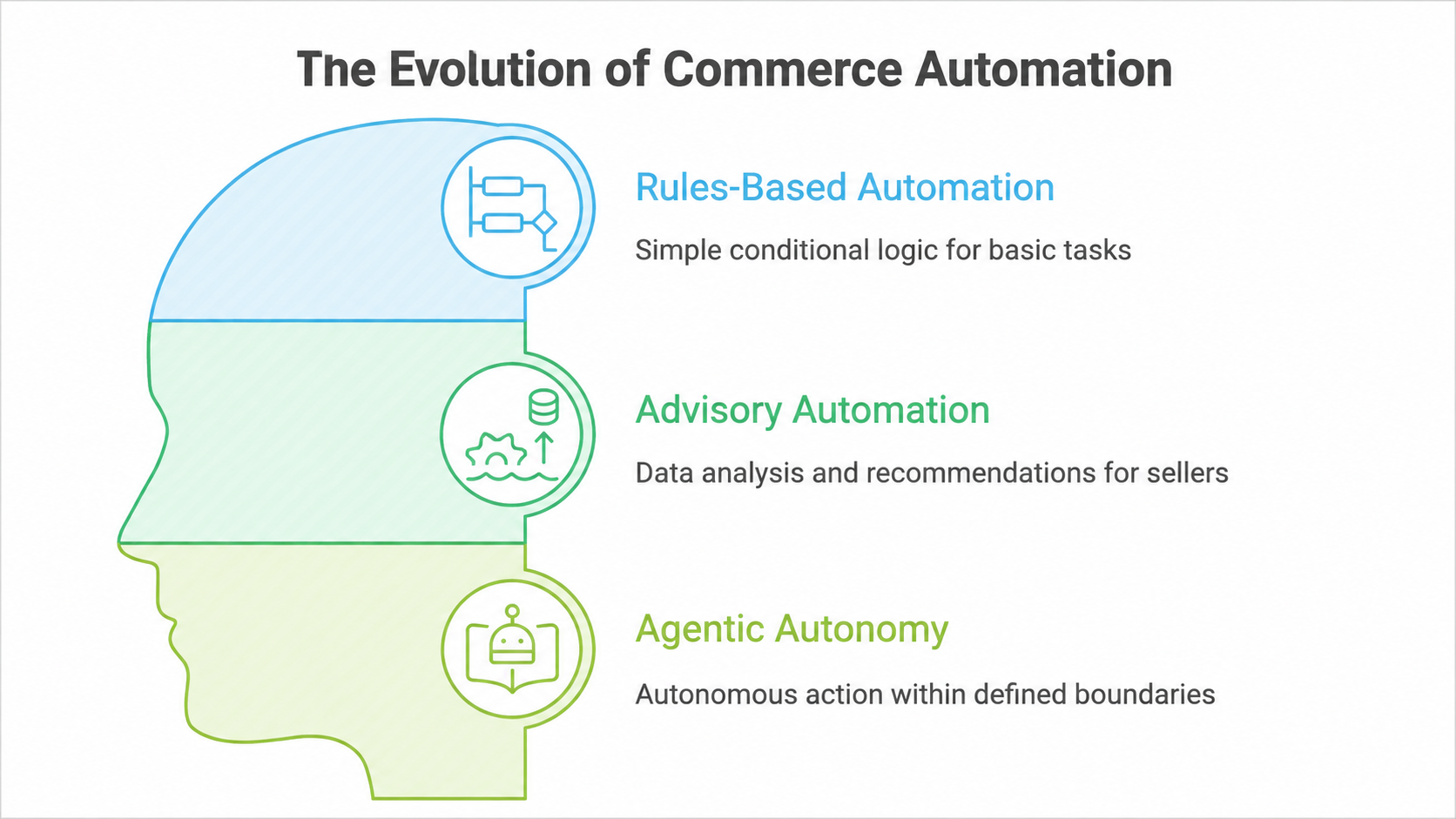
The capability spectrum
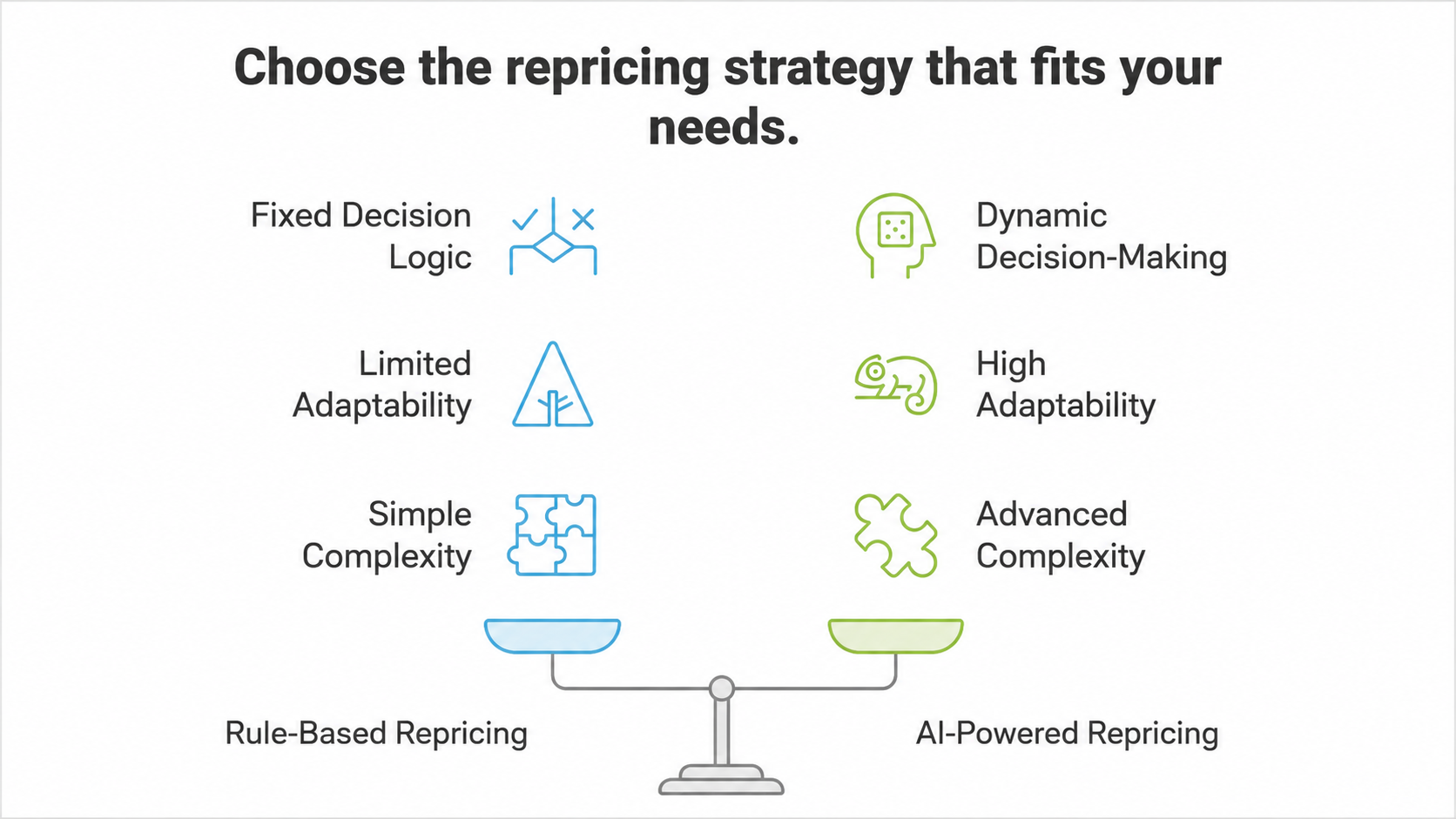
Level 1: Rules-based automation. “If competitor price drops below X, match minus $0.01.” This isn’t AI. It’s conditional logic. But it’s what most “AI-powered” repricing tools actually do. The seller defines the rules. The system executes them. No learning occurs.
Level 2: Advisory automation. The system analyzes patterns and makes recommendations. “Based on demand trends, consider increasing price on ASIN X by 5%.” The seller reviews the recommendation and decides whether to act. This is where most advanced analytics tools operate. They process more data than a human can, but the human remains in every decision loop.
Level 3: Agentic autonomy. The system analyzes patterns, makes recommendations, and, within boundaries the seller defines, executes actions autonomously. “Demand trending up on ASIN X, competitor stocking out. Increased price by 3% within your defined guardrail of +/- 5%. Margin impact: +$0.87/unit.” The seller is informed, not consulted. They can override, but the system acted before the opportunity passed.
The distinction between Level 2 and Level 3 is the distinction between a financial advisor and a portfolio manager. The advisor recommends. The manager acts, within an investment policy statement you defined. The advisor requires your attention for every decision. The manager requires your attention only when conditions exceed the defined parameters [1].
Why agentic matters for commerce
Amazon’s marketplace operates in real-time. Competitive price changes, inventory fluctuations, advertising bid adjustments, and Buy Box rotations happen continuously, 24 hours a day, 7 days a week. An advisory system that generates a recommendation at 9:00 AM for a competitive change that happened at 2:00 AM has a 7-hour gap. During that gap, margin was lost, Buy Box share shifted, and advertising spend was misallocated.
An agentic system that detects the competitive change at 2:00 AM, evaluates the inventory position and margin impact, and adjusts pricing at 2:01 AM, within the seller’s defined guardrails, captures value that no advisory system or human operator can.
The math is direct: in a marketplace that moves continuously, a system that acts continuously captures more value than one that waits for human approval on every decision. The question is whether sellers trust the system enough to grant that autonomy.
The trust architecture
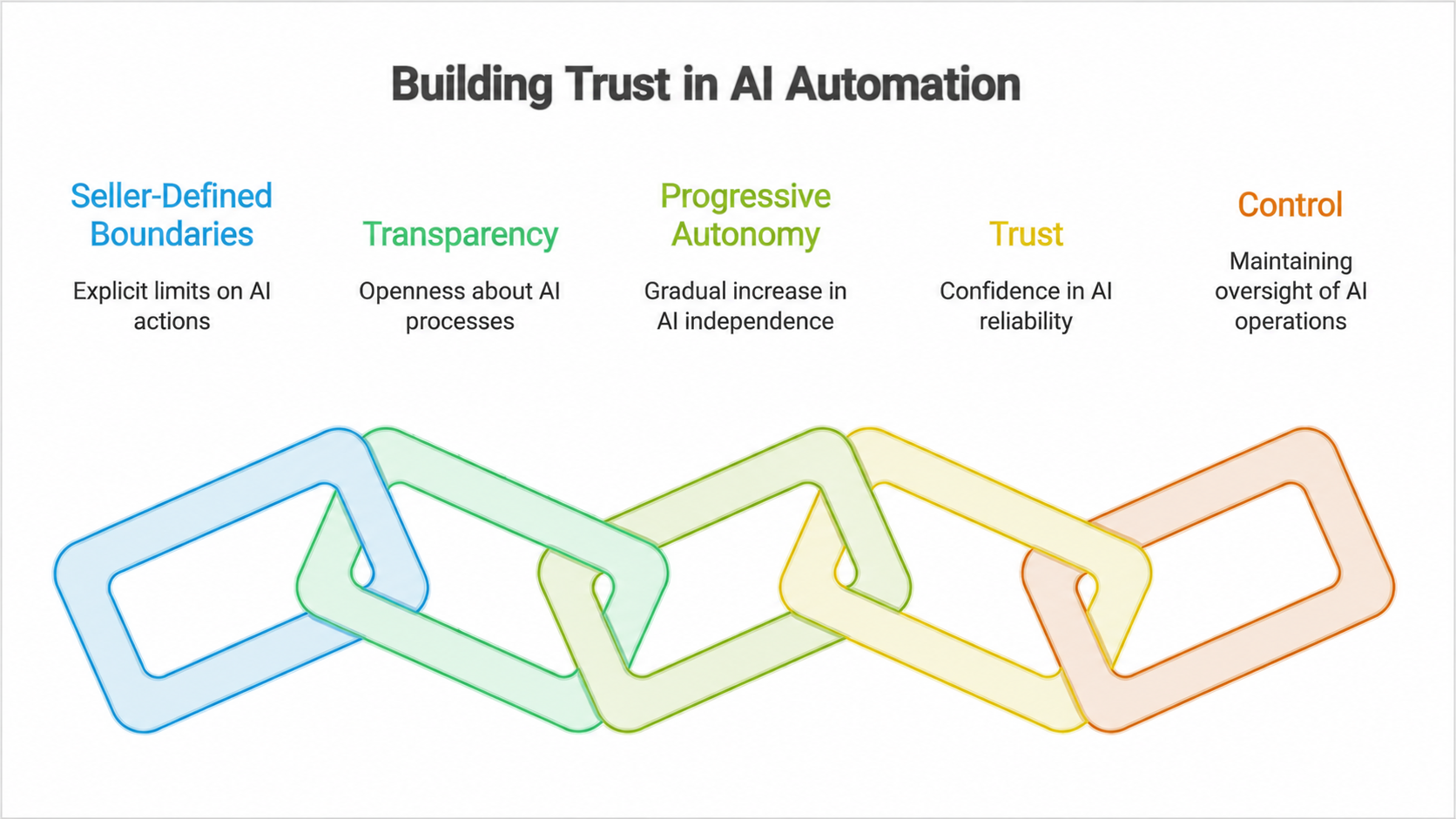
Trust in agentic systems isn’t built through marketing claims. It’s built through three architectural principles.
Transparency: every action the system takes is logged, explained, and visible. The seller can see what happened, why the system decided what it decided, and what the outcome was. There are no black-box decisions.
Bounded autonomy: the seller defines the operating boundaries before granting autonomy. Maximum price change per adjustment. Minimum margin floor. Maximum daily advertising spend change. The system cannot exceed these boundaries, regardless of what the data suggests. If the optimal action exceeds the boundary, the system surfaces the decision to the seller instead of acting.
Reversibility: every automated action can be reversed. If the system raises a price and the seller disagrees with the reasoning, a single action restores the previous state. The system learns from the override, adjusting its model for future similar situations.
How Realify implements agentic commerce
Realify’s autonomous capabilities are designed on these principles. When you connect your Amazon account, you don’t immediately hand over autonomous pricing control. You start in advisory mode, the system makes recommendations, you review and approve. As you build confidence in the system’s judgment, you progressively expand its autonomy by widening guardrails.
A seller might start with: “Recommend pricing changes, but I approve everything.” After two weeks of reviewing recommendations and seeing alignment with their strategy, they shift to: “Execute pricing changes up to +/- 3%, flag anything beyond that.” After a month: “Execute pricing changes up to +/- 5%, adjust advertising bids within 20% of current levels, and flag inventory reorder recommendations for my review.”
This progressive trust-building is how every successful automation deployment works, in commerce, finance, logistics, and every other operational domain. The sellers who will benefit most from agentic commerce are those who understand that the goal isn’t to remove human judgment. It’s to deploy human judgment at the right level of abstraction, setting strategy and guardrails rather than making individual operational decisions.
- •[1] Progressive autonomy patterns documented in autonomous systems deployment research, financial services algorithmic trading adoption, and logistics automation case studies, 2020-2025.