The repricing tool market is one of the most crowded in Amazon’s software ecosystem. Dozens of tools offer “automated” or “AI-powered” repricing. But the majority of these tools operate on rule-based logic, not actual intelligent decision-making, and the distinction has meaningful implications for sellers.
What rule-based repricing does
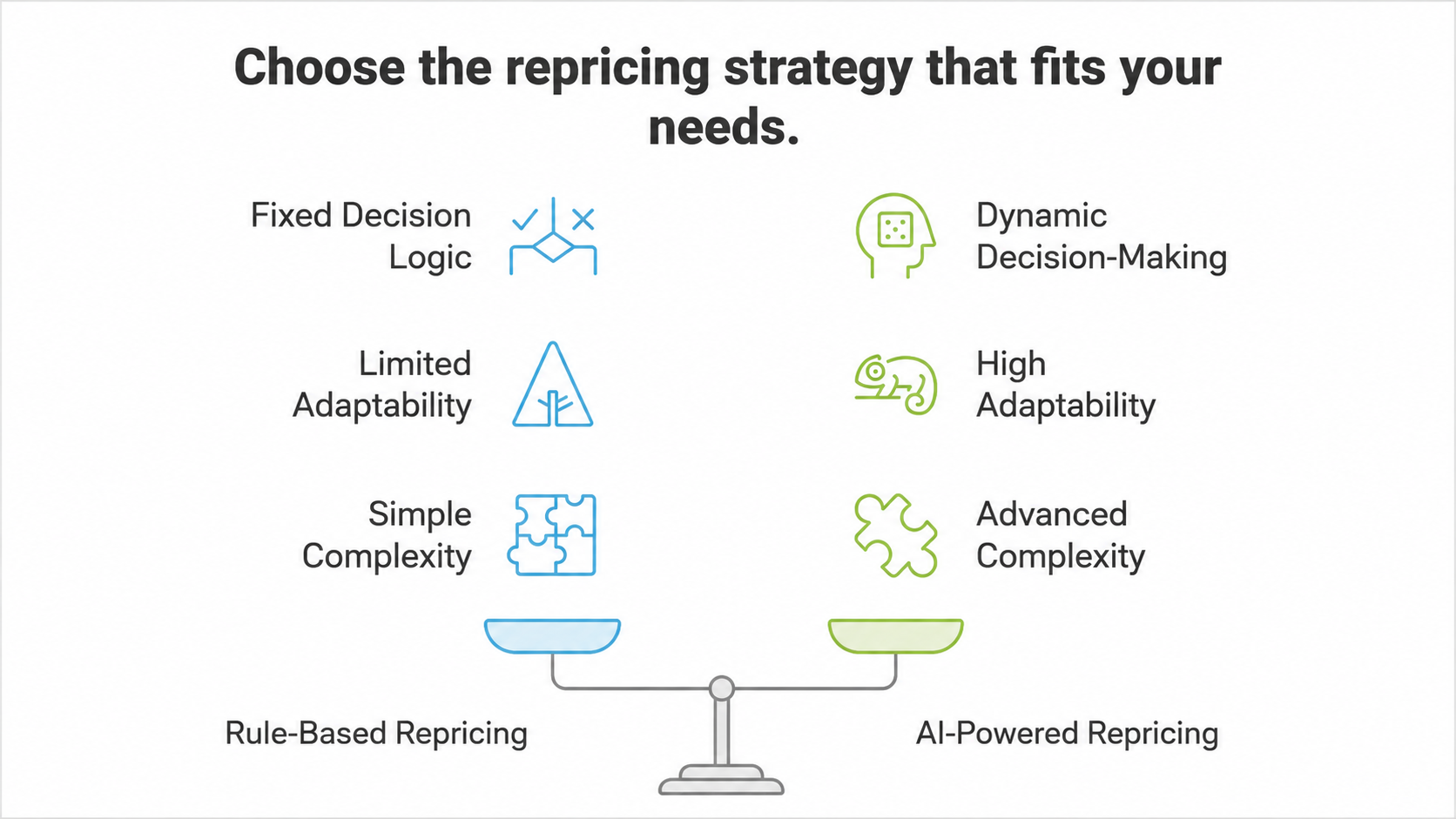
A rule-based repricer executes conditional logic that the seller defines. The most common rules: “If my price is higher than the Buy Box price, match it minus $0.01.” “If I’m winning the Buy Box, raise price by $0.50.” “Never price below $X.” These rules execute deterministically, given the same inputs, they always produce the same output. They’re fast, predictable, and straightforward to follow.
Rule-based repricing works well for commodity products with high competition where the Buy Box is primarily price-driven. In these categories, the competitive dynamic comes down to one thing: lowest qualified price wins. A repricer that tracks the Buy Box price and adjusts accordingly captures most of the available value.
Where rules break down
Rules break down when the competitive dynamic isn’t purely price-driven, which is most categories for sellers doing $500K+ annually with branded or differentiated products.
Consider a scenario where your competitor drops their price by 10%. A rule-based repricer matches the drop. But what if the competitor is clearing inventory ahead of a discontinuation? Matching their clearance price on a product they’re about to stop selling destroys your margin for no competitive benefit. They’ll be gone in two weeks regardless.
Or consider a scenario where demand for your product spikes due to a trending social media post. A rule-based repricer doesn’t see demand signals. It only sees competitor prices and Buy Box status. An intelligent system that incorporates demand signals would recognize the surge and raise prices to capture the additional margin that elastic demand supports.
Rules optimize for one variable (price relative to competition). Intelligent systems optimize across multiple variables simultaneously (price, demand, inventory, margin, advertising, and competitive context).
How Realify’s pricing intelligence works
Realify’s pricing capability operates on multi-variable optimization, not rule-based logic. When evaluating a pricing decision, the system considers: the competitive price landscape (same as a repricer), but also current inventory position (can you sustain the velocity a lower price would generate?), advertising investment on this ASIN (is the current spend justified at the proposed price?), demand signals (is velocity trending up or down independent of price?), margin impact (does the proposed price exceed your guardrails?), and cross-channel implications (would a price change on Amazon affect your Shopify or Walmart positioning?).
The result is pricing decisions that account for the business context, not just the competitive context. For commodity products, the output may be identical to a rule-based repricer. For branded or differentiated products, the output will often be materially different, and materially more profitable.
- •[1] Rule-based repricing limitations documented in third-party repricing platform and analytics research, 2024-2025.