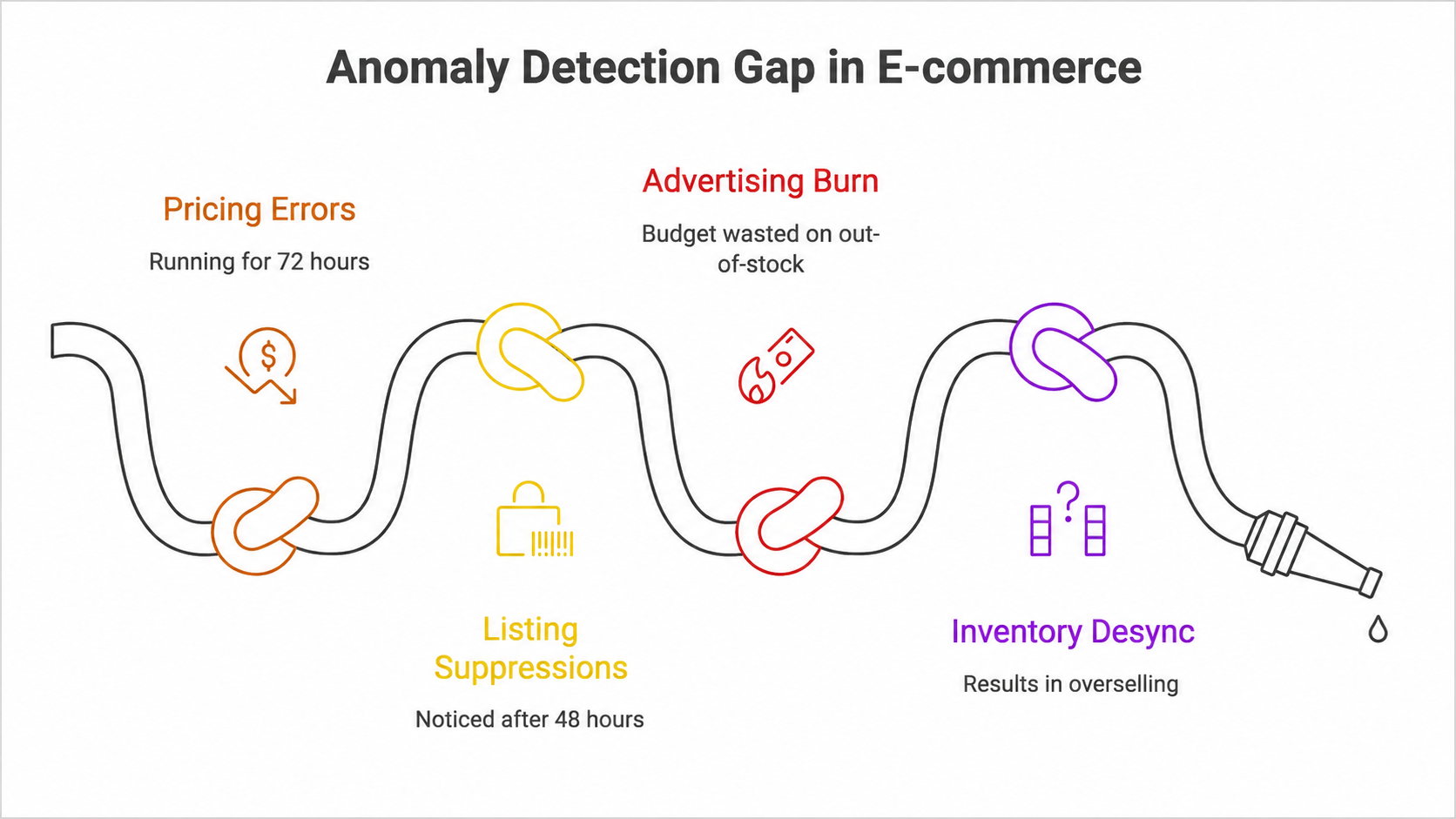
A pricing error running for 72 hours. A listing suppressed for 48 hours before anyone notices. An advertising campaign burning budget on an out-of-stock ASIN for a full weekend. An inventory desync between Amazon and your 3PL that results in overselling.
These aren’t hypothetical scenarios. They’re the daily reality of multi-channel commerce, and they share a common characteristic: the seller discovers them days after they began, when the financial damage is already done.
Why late detection is the default
The detection gap exists because of how sellers interact with their tools. Most sellers review operational data once or twice per day, a morning dashboard check and sometimes an evening reconciliation. The tools themselves may surface alerts, but those alerts are: scattered across multiple platforms (one tool for pricing, another for inventory, a third for advertising), not prioritized by financial impact (a $50 advertising overspend and a $5,000 pricing error may generate the same notification), and often buried in email inboxes alongside hundreds of other notifications.
The result is that time-sensitive operational issues compete for attention with routine notifications. The pricing error that started at 2:00 AM doesn’t get the seller’s attention until 9:00 AM, 7 hours of undetected impact. If it’s a subtle error (3% off target rather than 50% off target), it might not register as an anomaly in the morning review at all, extending detection to the weekly margin analysis.
The cost of every hour
Anomalies in commerce operations don’t have linear costs. They compound. A pricing error doesn’t just cost the margin on units sold at the wrong price. It triggers competitive repricing cascades, distorts inventory velocity, and misallocates advertising spend. Each hour the anomaly runs, the remediation cost grows.
Based on modeling of common anomaly types, the relationship between detection time and total cost is roughly: 1-hour detection: direct cost only (containable). 4-hour detection: direct cost + competitive cascade begins. 24-hour detection: direct cost + competitive cascade + inventory velocity distortion + advertising waste. 72-hour detection: all of the above + recovery period extending 48-72 hours beyond correction.
Proactive detection as an operating principle
Realify monitors every operational surface continuously, pricing, inventory, advertising, listing status, seller metrics, and competitive positioning. When any metric deviates from expected range, the system evaluates financial impact and surfaces the anomaly with the appropriate urgency.
Critically, Realify detects anomalies that no single tool can identify because they span domains. A pricing change that causes an advertising efficiency drop. An inventory level change that affects Buy Box eligibility. A listing suppression that makes active advertising spend wasteful. These cross-domain anomalies are invisible to point solutions and visible only in a system that sees the full operational picture.
The goal isn’t to eliminate errors. They’re inevitable in any complex operation. The goal is to detect them in minutes instead of days, reducing the compounding cost from five-figure events to containable incidents.
- •Based on anomaly cost modeling and seller-reported detection timelines from Amazon Seller Central forums, 2025.