Marketplace platforms process billions of transactions annually. The fee calculations behind those transactions are automated, and automated processes at scale can produce discrepancies. For individual sellers, these discrepancies are small enough per transaction to go unnoticed, but they compound across hundreds of SKUs and thousands of orders into meaningful margin gaps.
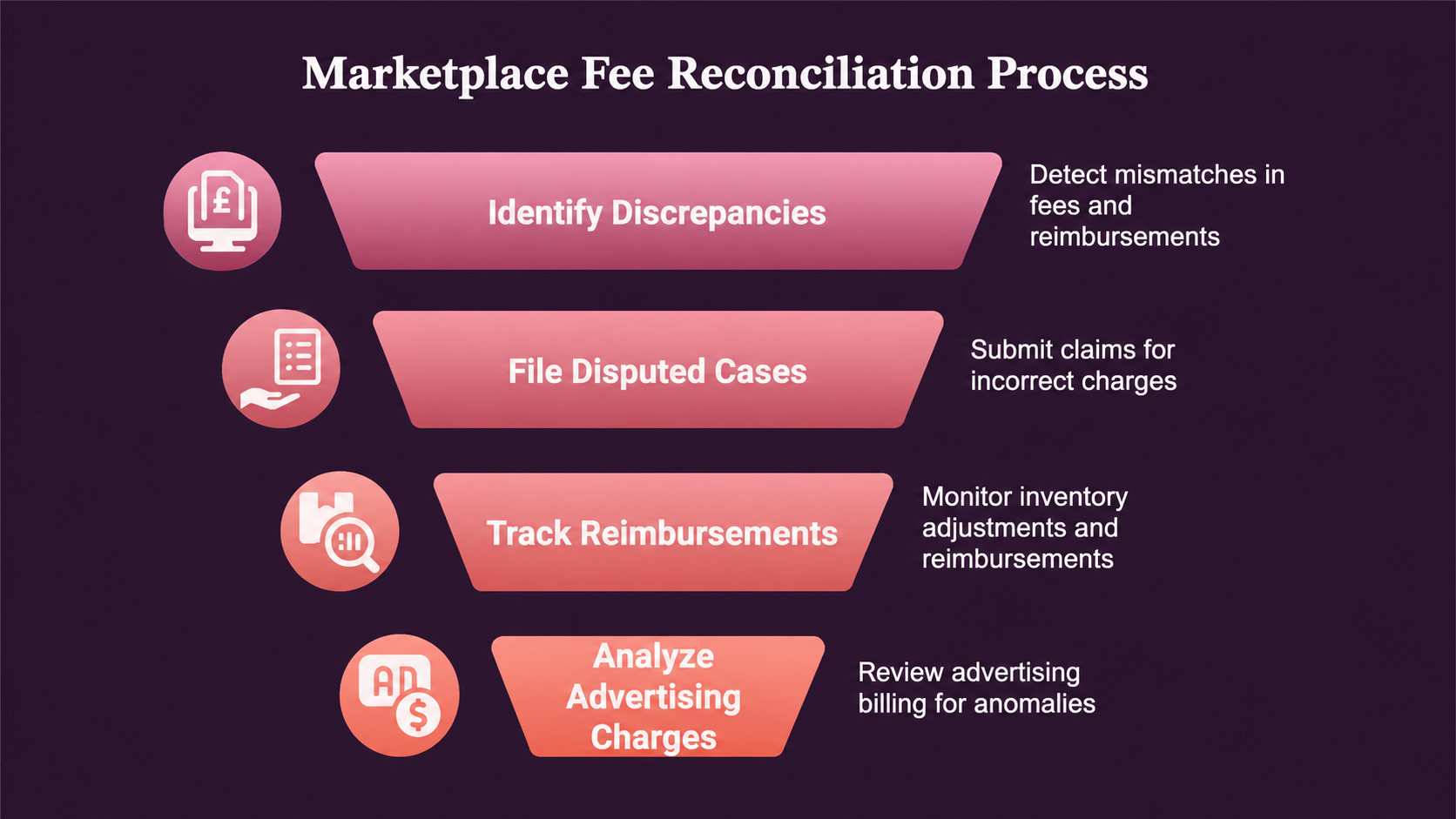
The three most common fee discrepancies are dimensional weight mismatches, missed reimbursements for lost or damaged inventory, and advertising billing anomalies.
Fulfillment fee tier discrepancies
Fulfillment fees are determined based on product size and weight tiers. When your products arrive at fulfillment centers, they are measured and assigned to a tier. If the assigned tier is higher than your own product dimensions indicate, you may be billed at a higher rate than expected on every unit fulfilled.
The discrepancy rate is higher than most sellers expect. Industry estimates suggest that 5-15% of ASINs have dimensional weight assignments that don’t match the seller’s product specifications. The billing variance per unit ranges from $0.20 to $2.00+ depending on the tier boundary crossed [1].
For a seller with 300 ASINs shipping 10,000 units per month, even a 5% discrepancy rate at an average $0.50 overcharge means $2,500 per month, $30,000 per year, in excess fulfillment fees.
A process exists for disputing dimensional weight assignments, but it requires the seller to identify the discrepancy, file a case with supporting measurements, and follow up until resolution. Most sellers never audit for this because the per-unit discrepancy is small enough to be invisible in aggregate reporting.
Unreimbursed lost and damaged inventory
Fulfillment program agreements include provisions for reimbursing sellers when inventory is lost or damaged within the fulfillment network. Internal systems catch some of these events automatically and issue reimbursements. Not all eligible events are automatically flagged.
Sellers who systematically audit for unreimbursed lost and damaged inventory typically recover 1-3% of their annual FBA costs. For a seller doing $3M annually with $500K in FBA fees, that’s $5,000 to $15,000 in recoverable reimbursements [2].
The audit process involves reconciling: inventory received reports (what you sent to the fulfillment center), inventory adjustments (what was recorded as damaged, lost, or found), and reimbursement reports (what was paid out). Discrepancies between what was lost and what was reimbursed represent recoverable claims.
Advertising billing discrepancies
Advertising billing systems charge for clicks. The vast majority of these charges are accurate. But discrepancies can occur: clicks recorded outside your campaign’s geographic targeting, charges for clicks on paused campaigns during transition windows, and cost-per-click charges that exceed your maximum bid (rare but documented).
For most sellers, advertising billing anomalies represent a small percentage of total spend, typically under 1%. But for sellers spending $50K+ monthly on advertising, even 0.5% represents $250/month in overcharges.
How Realify handles fee reconciliation
Realify’s margin tracking system continuously reconciles marketplace fee charges against expected values. When a fulfillment fee doesn’t match the expected tier for a product’s dimensions, the system flags it. When inventory adjustments don’t have corresponding reimbursements within the standard processing window, the system identifies the gap. When advertising charges deviate from campaign parameters, the system alerts.
This isn’t a quarterly audit. It’s continuous monitoring. The system catches discrepancies as they occur, enabling faster resolution and preventing months of accumulated overcharges before detection.
- •[1] Dimensional weight discrepancy rates reported by FBA reimbursement service providers and Amazon seller forums, 2025.
- •[2] Recovery rates documented by managed refund service providers and FBA reimbursement specialists.