In January 2025, automated title enforcement was implemented across all categories. The system identifies non-compliant titles, generates “override suggestions,” and gives brand owners 14 days to make corrections before the platform applies its own modifications.
Many sellers missed these notifications entirely, as they were buried within the platform’s notification system, and had their titles auto-modified without realizing it [1].
One documented case: a seller’s listing for “Wireless Bluetooth Headphones with Active Noise Cancellation, 40-Hour Battery Life” was automatically shortened to “Wireless Bluetooth Headphones.” The two features that differentiated the product from 200 competitors, the noise cancellation and battery life, disappeared from the title. Traffic dropped 20-30% before the seller noticed.
This isn’t an isolated incident. It reflects how automated governance now operates across modern marketplaces.
The automated enforcement landscape
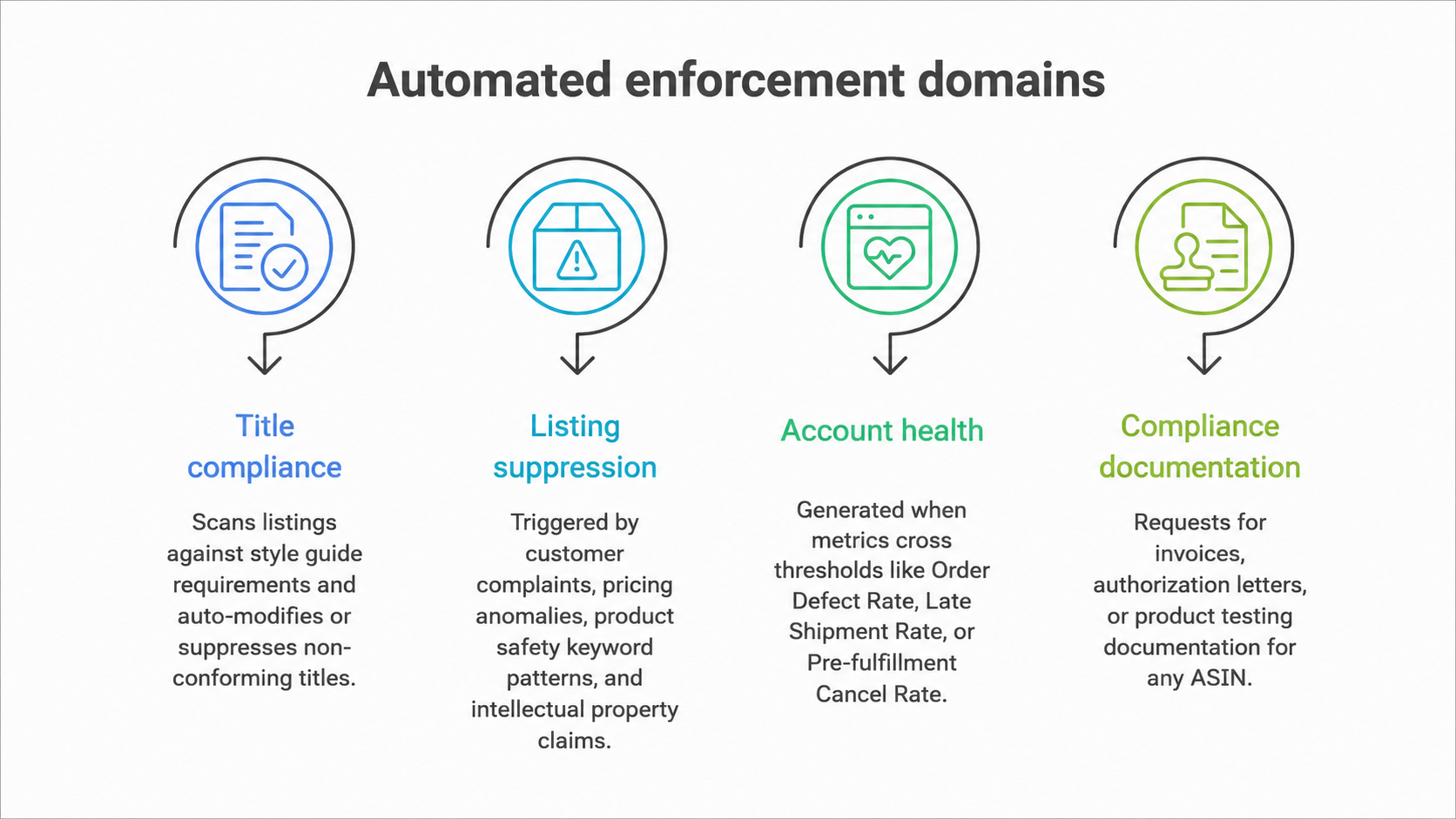
Automated systems make decisions about seller accounts across multiple domains, and most of these decisions happen without initial human review.
Title compliance enforcement scans listings against platform style guide requirements and auto-modifies or suppresses listings that don’t conform. The system looks for: excessive character length, unauthorized promotional phrases (“best seller,” “limited time”), inconsistent capitalization, and characters that don’t match category-specific templates.
Listing suppression can be triggered by a variety of automated signals: customer complaints, pricing anomalies (if your price is dramatically lower than competitors, the system may flag a potential error and suppress the listing), product safety concerns flagged by keyword patterns, and intellectual property claims from other brands.
Account health flags are generated automatically when seller metrics cross thresholds, Order Defect Rate above 1%, Late Shipment Rate above 4%, or Pre-fulfillment Cancel Rate above 2.5%. These flags can restrict your ability to list new products, access advertising features, or maintain Buy Box eligibility.
Compliance documentation requests can arrive at any time. The platform system may request invoices, authorization letters, or product testing documentation for any ASIN, and if the documentation isn’t provided within the specified window (often 7-14 days), the listing is suppressed. One seller in a community forum reported that 700 items were removed from inventory pending documentation that, in many cases, was straightforward to provide once the request was identified [2].
Why proactive monitoring matters
The common thread across all automated enforcement is that the seller discovers the action after it’s already taken effect. Your title was changed, but you didn’t know until traffic dropped. Your listing was suppressed, but you didn’t know until a customer told you. Your account health flag was raised, but you didn’t check the dashboard until the restriction was already applied.
This reactive discovery pattern is inherent to how most sellers interact with their marketplace accounts, checking in when they have time, not in real-time. Notification systems across platforms are structured differently: some actions generate emails, others surface within dashboards, and some require navigating sub-menus to find.
How Realify addresses automated enforcement
Realify monitors your account health, listing status, and compliance signals continuously. When automated systems take action on your listings, title modifications, suppressions, compliance requests, account health flags, Realify surfaces it immediately as an alert, not as a line item buried in a dashboard.
More importantly, Realify detects the precursors to automated enforcement. When your listing title approaches character limits or contains phrases that the platform’s style guide flags, the system alerts you before enforcement triggers. When your seller metrics trend toward threshold boundaries, the system identifies which orders are degrading your scores and recommends corrective action before the threshold is crossed.
The difference between catching an automated action after it happens (and spending days resolving it) and preventing it from triggering in the first place is the difference between reactive operations and proactive operations. In a marketplace governed increasingly by autonomous systems, the sellers who survive are the ones whose own systems are watching just as vigilantly.
- •[1] Canopy Management, “Amazon’s Invisible Challenges: A Strategic Analysis for 2026” – automated title enforcement affecting seller traffic by 20-30%.
- •[2] Amazon Seller Central Forums, seller discussions on automated compliance actions, 2025.